
Strait of Hormuz Impact on Indian Exporters 2026: What You Must Know Now
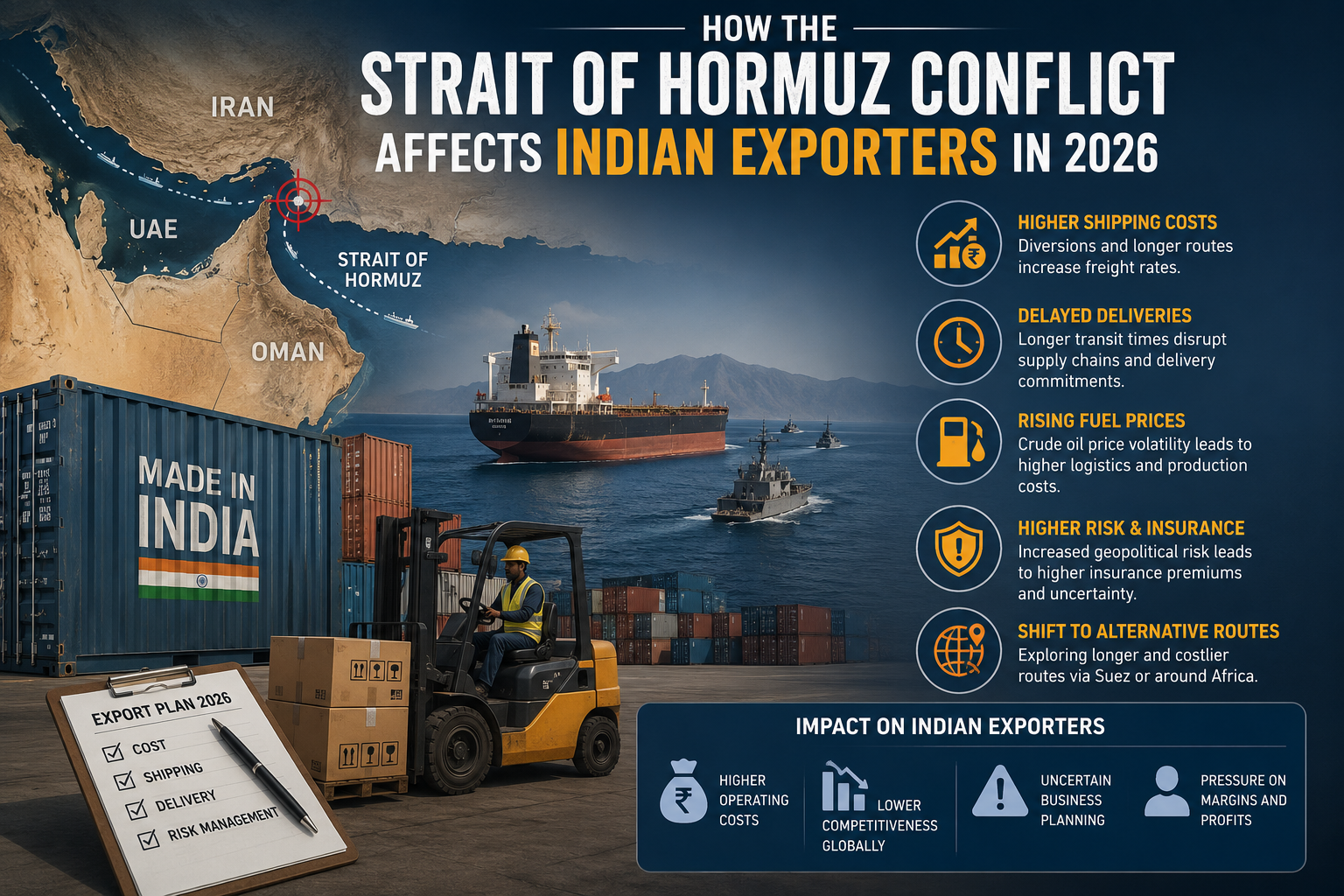
In 2026, on February 28 the coordinated US and Israeli airstrikes against Iran resulted in the nearly-complete closing to the Strait of Hormuz. Ships that transited daily through the strait slowed from more than 130 to less than 10. According to the International Energy Agency called it the biggest supply disruption in the time of the world's oil market.
India is at the heart of the current crisis. India is the world's third-largest importer of crude oil fourth-largest refiner and fifth-largest exporter of petroleum goods. Nearly 50 percent of India's crude oil imports pass through the Strait. What happens within that 21-mile-wide channel that runs between both the Persian Gulf and the Arabian Sea impacts Indian enterprises -- and even exporters -- in a matter of days, not weeks.
This guide explains precisely what Indian export industries are impacted as well as how and the steps exporters should take to safeguard their business now.
What the Strait of Hormuz Actually Is
It is the Strait of Hormuz is the only exit to the sea for the majority of Gulf energy producers - Iran, Iraq, Kuwait, Qatar, UAE, and Bahrain. In 2025, approximately 20.3 millions barrels of crude oil passed through daily, which is about 20% of the world consumption of petroleum. About 20% of world LNG trade was transited through it, heading for Asia. Saudi Arabia and the UAE have a limited pipeline capacity that is able to avoid the Strait Most other Gulf producers don't have any. It is the US Energy Information Administration has declared that any closure quickly restricts global supply, with no viable alternative for rerouting the vast majority of Gulf exports. From February 28 this scenario has been unfolding.
The Direct Commodity Impact on India
Crude Oil and Energy Costs
Understanding the Strait of Hormuz India trade 2026 picture starts with crude. The crude oil market in India nearly tripled in just a month following the closure between $169 for a barrel during February, to $126 in March, and a peak of $157 per barrel. Oil prices that exceed $100 have been in place for several months.
India's India crude oil import disruption response involved expanding its crude sourcing to the US, Russia, and West Africa. Indian refineries have maintained the production rate, but at a higher costs. Prices for procurement are rising. Costs for freight on longer routes have added additional costs. Marine insurance premiums for all cargo bound for India including Gulf route, have increased dramatically as insurers factor in more general geopolitical risks.
For Indian exporters the cost of energy affects production costs in nearly every industry. Packaging, transportation, power and processing of raw materials all require energy. When energy costs double the production costs increase all over all areas.
Fertilizers
India receives 18 percent of its urea imports from Gulf producers. And around 46% of global trade in urea is tied directly to Gulf producers whose exports go through Hormuz. An extended disruption can increase the cost of agricultural inputs that result in food inflation and decreases its pricing efficiency of Indian exporters of agricultural and food products on the international market.
LNG and Petrochemicals
Qatar has declared a force majeure over LNG exports following missiles damaged the Ras Laffan plant. South Asia depends on the Middle East for nearly 90 percent of its butane as well as propane imports, causing a lot of damage to Indian producers of petrochemicals who rely on LPG and LNG as feedstocks. The Indian government halted customs duties on petroleum-based products up to June 30 2026 in order to prevent costs from escalating in plastics textiles and pharmaceuticals.
How This Hits Indian Exporters Sector by Sector
The Middle East conflict India supply chain disruption is not hitting all sectors equally. Here is what each major export industry is facing.
Textile and Apparel Exporters
Textiles are heavily dependent on the petrochemical inputs synthetic fibers, dyes, and finishing chemicals. Costs of energy and feedstock are rising. reduce margins already suffering due to US tariffs. The freight cost increase for Indian exporters on India-to-Europe and India-to-US routes has risen because global shipping capacity is shifting towards the Gulf. A Indian exporter of garments who quotes the European buyer today will have to pay increased input costs, greater freight costs, and more insurance costs than it did three months ago - all in one go.
Pharmaceutical Exporters
India's pharmaceutical industry uses large amounts of APIs as well as organic chemicals, with some coming from or transported through the Gulf. Exporters that depend on APIs have increased. The exemption of customs duties on the use of petrochemicals offers a small amount of relief. However, the government has announced that it is likely to extend the exemptions if conflict continues.
Agricultural and Food Exporters
Costs for fertilizers that are higher increase the cost of production for Indian rice and wheat, as well as spice along with sugar importers. Freight costs for alternative routes add cost to all food exports that originate from India and have reduced the competitive advantage Indian exporters have over rivals. In the Middle East is India's second-largest food export market. A disruption to the Gulf also results in a delay in purchasing for Middle Eastern importers, directly cutting the order volume for exporters that have Gulf buyers.
What Indian Exporters Should Do Right Now
Examine your structure of input costs right away. Identify which of your raw materials packaging, energy as well as freight prices are connected directly to Gulf chain of supply or pricing. Check your exposures before making the assumption that your margins are secure.
Secure freight contracts right now. Shipping capacity on other routes is reducing. Exporters who do not act now face increased rates and fewer options. Forward freight agreements offer the assurance of cost that spot booking does not offer anymore.
Prices for buyers are available right away. If your cost base has increased 15 to 25 percentage since January 20,2026 and your export pricing must reflect this. Buyers know the impact. The cost of absorbing increases in costs without repricing reduces margins while keeping the competitiveness.
Diversify away form Gulf-centric buyers. Exporters with heavy Middle Eastern buyer exposure face the same pressures on their costs and also orders pauses due to the same issue. The time is now to accelerate EU as well as Africa market growth now the the FTA between India and EU is in place and Indian products are more competitive on these markets than they were at any time in the past.
Watch the extension of customs duty exemption. India removed duties on petrochemicals with critical inputs, until June 30th 2026. If these exemptions are extended beyond the date of expiration will be a major cost factor for chemical, textile as well as pharmaceutical companies. Follow DGFT along with Ministry of Finance announcements on this matter closely.
Make buffers for input inventory. For manufacturers dependent on LNG-derived Gulf-sourced LPG, Gulf-sourced chemicals or fertilizers, the risk of lean inventory is high in the present. Set up buffers for 30 to 60 days when storage is possible. Storage of inventory is cheaper than shutting down production.
What the Government Has Done So Far
The Ministry of Petroleum set up an all-hours control room to monitor fuel inventories across the country. The government announced on the 11th of March 2026 that the stock of petrol as well as diesel and the aviation fuel inventory are enough to withstand temporary disruptions. Customs duties for critical petroleum products were temporarily waived. Refiners were assisted by securing alternative crude imports coming from US, Russia, and West Africa. India can handle disruptions in the short term by utilizing buffer reserves and diversification however, a longer closing will require structural changes.
The Bigger Picture for Indian Exporters
The Strait of Hormuz impact on Indian exporters in 2026 is a reminder to all of the fact that supply chains can only be as durable as their weakest chokepoint. COVID-19 exposed concentration of production. Ukraine exposed the energy and food dependence. The Strait of Hormuz has now exposed maritime route dependency.
India's strength in exports of textiles, pharmaceuticals and food products, and engineering is structural. The disruption increases prices and causes friction. However, it does not alter the basic performance for Indian manufacturing for buyers from abroad who require reliable supply partners. The exporters that will be the most successful will be those who make use of this period to diversify buyers' geographical locations, decrease Gulf-focused input exposure, and establish a confirmed B2B platforms with EU as well as African buyers who are actively looking for Indian suppliers today.