
India-UK CETA Agreement 2026: How MSMEs and Small Exporters Benefit
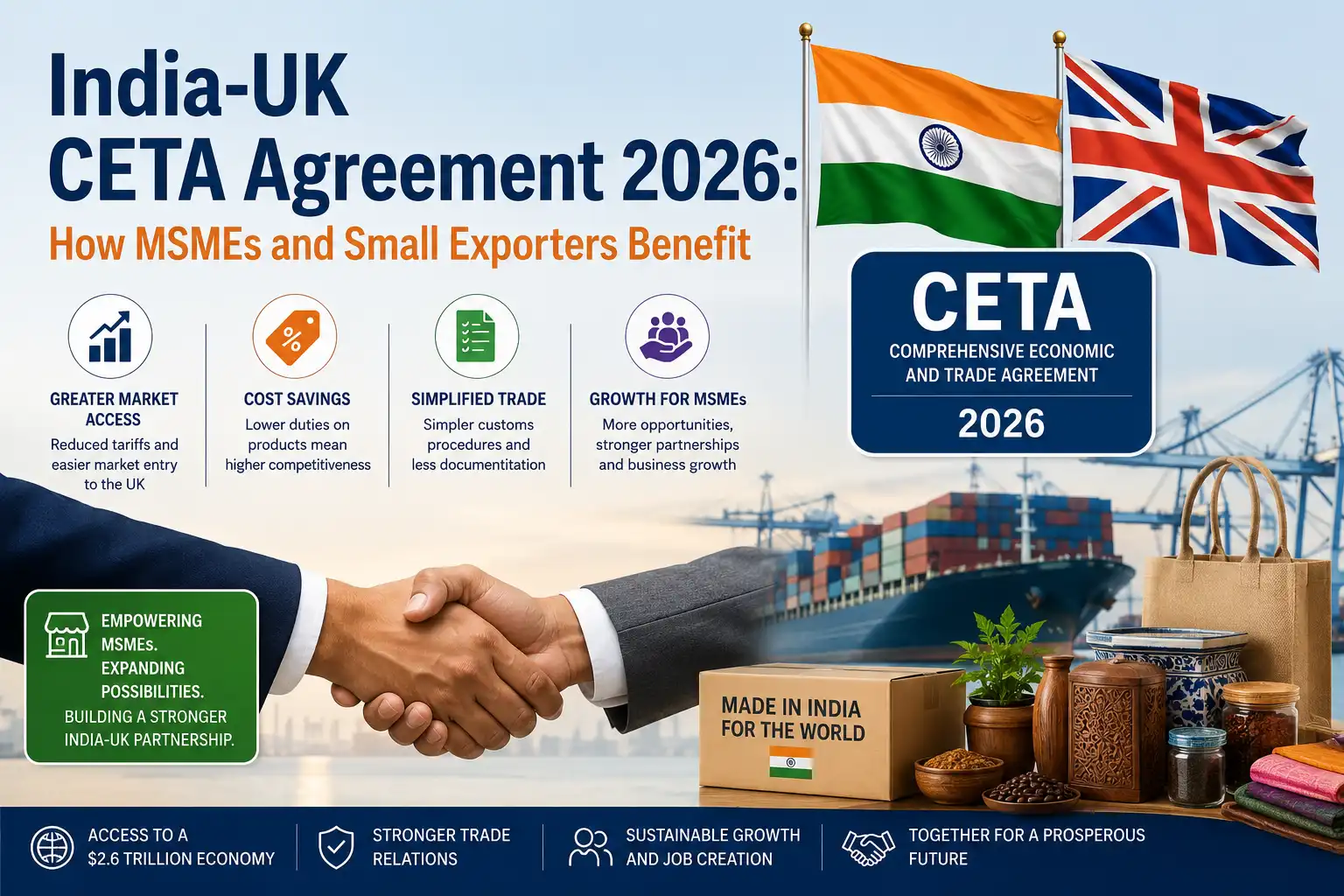
On July 15th 2026, the India-UK CETA agreement officially went into force, representing one of the greatest advances for small and medium exporters since signing of India-EU FTA earlier in 2026.
CETA stands for Comprehensive Economic and Trade Agreement. Incorporating tariff liberalization as one element, India-UK CETA covers products, services, digital trade and intellectual property protection as well as investment, intellectual property rights protection and labor mobility in 30 chapters. CETA is considered a "gold standard" agreement by Commerce Secretary Rajesh Agrawal, and PM Modi stated it would "give fresh momentum to our farmers, entrepreneurs and MSMEs."
This guide breaks down what the CETA agreement means for Indian MSME exporters, including sectors of advantage, alterations in tariffs, and the documentation processes involved, as well as tips for the preliminary steps of engaging with potential customers in the UK.
What is the CETA Agreement?
CETA stands for Comprehensive Economic and Trade Agreement, which is a bilateral free trade agreement signed between India and the United Kingdom in 2016. CETA represents one of India's most comprehensive trade agreements ever, covering 26 sectors ranging from tariff trade to technological trade. With about 20,000 pages committed to it, it is also one of the most extensive trading agreements India has signed.
What does the CETA trade agreement aim to do? The CETA trade agreement's main aim is to strengthen the trade relationship between India and the UK by increasing trade from $58 Billion in 2025-26 to $120 Billion by 2030. CETA is a comprehensive economic and trade agreement that eliminates tariffs on 99% of Indian exports sent to the UK. This is achieved by providing immediate implementation on the CETA agreement on July 15, 2026.
The India-UK Comprehensive Economic and Trade Agreement (CETA) officially commenced on July 15, 2026, marking a significant achievement on the part of Indian Diplomacy by providing nearly 99% of Indian exports in the UK's market duty free.
CETA countries include India and the United Kingdom. It is also important to distinguish it from the EU-Canada CETA agreement, which is a comprehensive economic and trade agreement that is separate from the Canada-Europe trade agreement. The India-UK CETA agreement is a bilateral trade agreement with India's first major Western partner.
What the CETA Agreement Means for Indian MSMEs
According to this report, trade barriers will be eased and markets will be more accessible to farmers, fishermen, MSMEs, and women entrepreneurs.
Commerce Minister Piyush Goyal said that this trade agreement gives "zero-duty market access for nearly 99% of India's exports, almost 100% of the trade value." CETA will give fresh momentum to farmers, entrepreneurs, and MSMEs. Many of the vibrant sectors will get better access to the UK market.
The CETA agreement provides for three things that, until now, required access to large enterprise resources for Indian MSMEs:
Access to UK markets without duties for MSMEs' strongest sectors, such as textiles, leather, handicrafts, processed foods, marine products, and gems (labor intensive sectors).
Integration into global value chains. The provisions of the agreement on services, digital trade, and investment will open new markets to MSMEs on the international stage.
Competitiveness across the board and across varied sectors such as food processing, engineering, textiles, gems, and jewelry. Digital trade. This Free Trade Agreement (FTA) will include many provisions on digital commerce and electronic transactions, thus supporting MSMEs who sell through B2B/D2C digital channels rather than through traditional trading channels.
Which Sectors Benefit From the CETA Agreement?
The agreement eliminates tariffs for all labour intensive sectors. For textiles, clothing, leather, gems and jewellery, engineering goods, chemicals, electronics, marine products, furniture and sports goods, the agreement provides zero-duty access. For the agricultural sector, the agreement provides zero-duty access to all products with the exception of chicken, pork, eggs, rice and sugar.
Here is what CETA provides for each sector:
Textiles and Apparel
Indian garments, fabrics, and home textiles face no tariffs under CETA, as the UK previously imposed tariffs of up to 12%. This levels the international playing field between Indian, Bangladeshi and Pakistani garment exporters, as the UK provided Bangladesh and Pakistan, but not India, tariff-free access to the UK market. Manufacturers in Tirupur, Surat, Panipat, and Ludhiana are the most likely beneficiaries of this agreement.
Leather and Footwear
With the CETA agreement, Indian leather goods and footwear now face zero tariffs. This is a direct benefit for manufacturing exporters in Agra and Tamil Nadu, as the UK market is now more accessible.
Marine Products
CETA removes a 21.5% tariff on Indian seafood. As India has a competitive advantage in shrimp exports, the UK is a price competitive market for Indian exporters. The beneficiaries of this agreement are the exporters of seafood in Andhra Pradesh, Gujarat, Kerala and Tamil Nadu.
Gems and Jewelry
Per the India UK CETA, India's gem and jewelry exports to the UK, currently at USD 1.25 billion, will be USD 2.5 Billion within 3 years, generating over 140,000 jobs. It will make India the world leader in diamonds, gold, silver, and lab-grown gems, in addition to all of these. The CETA free trade agreement was described by the GJEPC Chairman as having far-reaching effects on the Indian gem and jewelry industry.
Processed Foods
Tariffs on Indian processed food are reduced to zero in 18 years and 97.1% of food tariff lines will be duty-free. For Indian food MSMEs (including spice processors, pickle, and chutney manufacturers, and ready meal producers) CETA offers the highest tariff reduction. What was not viable for trade at a tariff of 70%, is now viable.
Engineering Goods
Tariffs of 18% on engineering goods and auto components will be eliminated. The complete elimination of UK tariffs will be beneficial for Indian exporters in many key sectors, including engineering goods.
How to Claim CETA Agreement Benefits
CETA will achieve tariff reductions automatically on 15th July 2026, and to claim those tariffs at UK borders, correct paperwork will be required.
Step 1: Check the correct tariff classification for your product. Your product must have the correct HS Code and must also be listed in the Schedule of Concessions in the CETA Agreement in the UK Trade Tariff at gov.uk/trade-tariff.
Step 2: Meet the Rules of Origin. Preferential tariff treatment as part of the India-UK CETA applies only to genuine Indian goods. Check the rules of origin for your HS code with your Export Promotion Council or the DGFT. Goods that are constructed in India with large imported components may not qualify.
Step 3: Prepare the documentation of origin. Movement Certificate EUR.1, endorsed by Indian Customs, shall be prepared for the shipment along with an origin declaration on the commercial invoice. UK Customs will assess the shipment with the most favoured nation tariff, if the documentation of origin is not provided.
Step 4: Tell your UK customer to register. Only UK importers that register with HMRC can benefit from the reduction in tariffs as part of the CETA trade agreement. Your customer cannot claim the duty reduction if he is not registered.
Step 5: Adjust your pricing. UK pricing must have improved by 12% to 70% relative to the previous pricing due to the reduction in tariffs. For buyers that previously perceived Indian goods as uncompetitive due to tariffs, re-open the pricing discussion and consider your UK pricing to be significantly more competitive.
Where to Find UK Buyers as an MSME Exporter
The CETA agreement establishes the tariff environment. Finding UK customers who want to source from India at zero duty requires a verified international B2B presence. Currently, UK importers who want to source textiles, leather, marine, processed food and engineering components from India want to see verified Indian suppliers on B2B platforms.
A completely verified profile on a platform such as Worldwide Exporter allows you to connect with buyers when Indian goods are competitively priced in the UK. The CETA trade agreement is active. Go to worldwidexporter.com and get your verified profile for free.
FAQs
What is the CETA agreement between India and UK? CETA agreement is the Comprehensive Economic and Trade Agreement. It is a bi-lateral free trade agreement effective from July 15, 2026. It enables Indian goods to be exported to UK without customs duty and covers 30 chapters.
What is the CETA agreement full form? CETA is Comprehensive Economic and Trade Agreement. The CETA agreement India-UK is not the CETA Canada-EU agreement, which is also a bi-lateral trade agreement.
Which Indian MSMEs benefit most from the CETA agreement? Indian MSMEs are in textiles, leather and footwear, marine products, processed foods, gems and jewelry, engineering goods with the customs duty diminishing to 0% in processed food.
Published on Worldwide Exporter Blog | worldwidexporter.com Category: Trade Policy | MSME Exporters | UK Market Tags: CETA agreement, ceta trade agreement, comprehensive economic and trade agreement ceta, what is ceta agreement, india uk ceta agreement, ceta agreement india benefits, ceta free trade agreement, india uk free trade agreement ceta