
India-EU Free Trade Agreement 2026: Complete Impact Guide for MSME Exporters
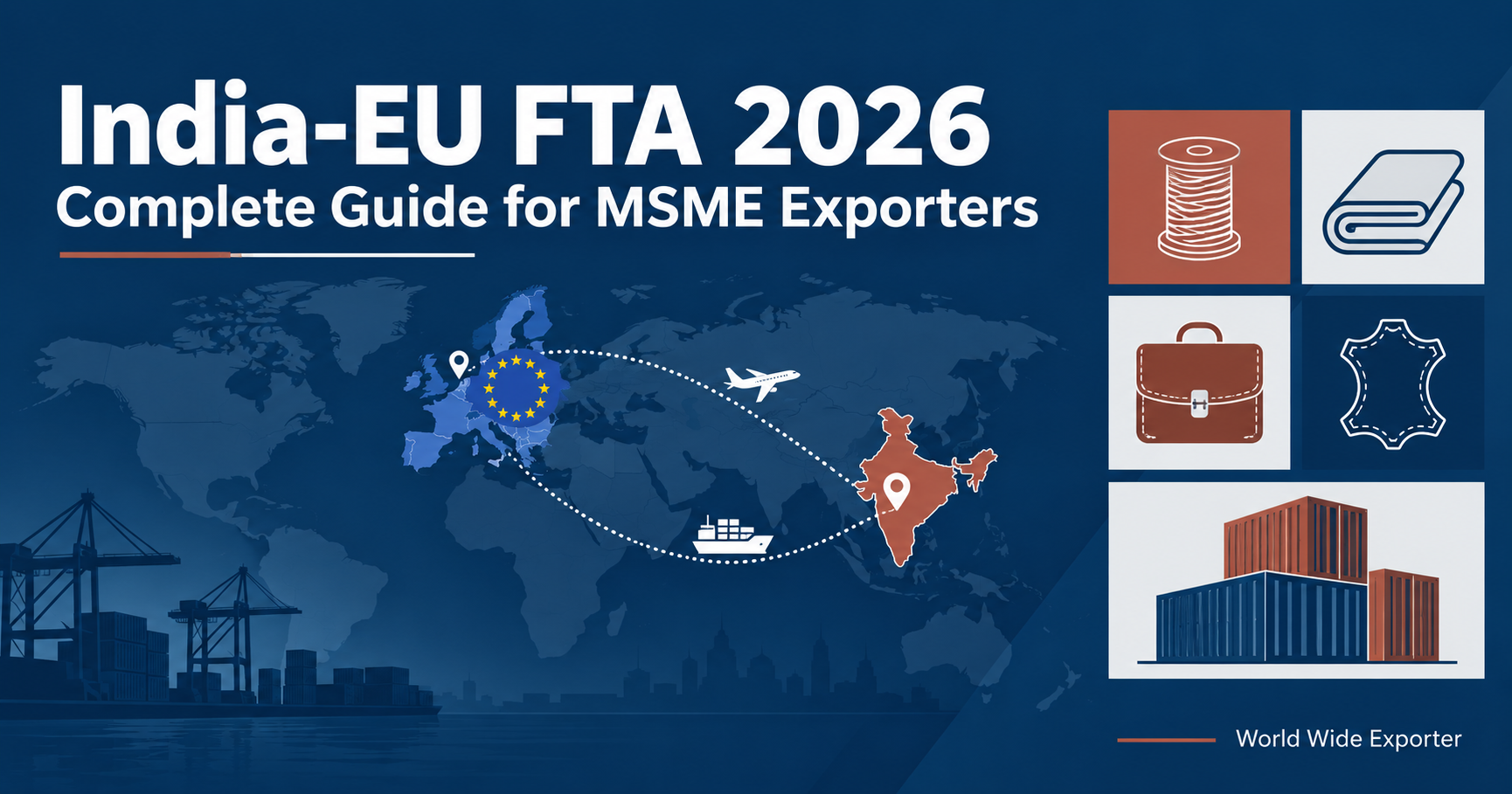
Quick summary: India and the EU concluded FTA negotiations on January 27, 2026. On September 11, 2026, the European Commission formally submitted its proposal to the EU Council for signature authorisation, confirming that legal vetting of the text is complete. Signing is expected by December 2026, with entry into force projected for early 2027, per the European Commission's own statement (source: newsonair.gov.in / PIB, dated September 11, 2026; no further developments reported as of September 17, 2026). Once in force, up to 99.5% of India's exports by value gain preferential access, with immediate zero-duty treatment for textiles, leather, gems and jewellery, marine products, and several other MSME-heavy sectors.
Key Takeaways
- The India-EU FTA has not yet entered into force. It is currently in the signature-and-ratification stage, not implementation.
- Once in force, the EU will remove duties on 97% of its tariff lines, covering 99.5% of India's exports by value.
- Textiles, leather, footwear, gems and jewellery, marine products, and select engineering goods get immediate zero-duty access on entry into force.
- India will cut tariffs on 92.1% of its own tariff lines, phased across categories including automobiles.
- A self-certification "Statement on Origin" system will replace traditional Certificate of Origin paperwork, cutting compliance costs for smaller exporters.
- The FTA includes a dedicated CBAM (Carbon Border Adjustment Mechanism) framework that MSME exporters in steel, aluminium, and related sectors should track closely.
- MSME exporters who prepare early on EU quality standards and buyer relationships stand to gain the most once the deal takes effect.
What Is the India-EU Free Trade Agreement
The India-EU FTA is a trade pact between India and the 27-member European Union, described by European Commission President Ursula von der Leyen as the "mother of all deals." Talks began in 2007, stalled for nearly a decade, and resumed in 2022. Negotiations formally concluded on January 27, 2026, at the 16th India-EU Summit in New Delhi. Full background is available on the European Commission's official India trade agreement page.
Together, India and the EU represent close to two billion people and roughly a quarter of global GDP. Annual bilateral trade in goods and services currently exceeds €180 billion, with the EU already ranking as India's largest goods trading partner.
Current Status: Where the Deal Stands (September 2026)
It is important for exporters to understand that concluding negotiations is not the same as the deal being active. Here is where things stand:
- January 27, 2026: Negotiations formally concluded.
- September 11, 2026: The European Commission put forward its proposal to the EU Council seeking authorisation to sign and conclude the agreement, stating that legal vetting and finalisation of the text are complete. (Confirmed as the latest status as of September 17, 2026, the day this guide was prepared.)
- Next steps: Council authorisation, formal signing (expected by December 2026), European Parliament ratification, and approval by the Indian Cabinet and Parliament.
- Expected entry into force: Early 2027, per statements from leaders on both sides, though this depends on how quickly the EU Parliament and Indian ratification processes move.
The text has completed legal scrubbing, the detailed clause-by-clause review to remove ambiguity before formal signature. Exporters should treat late 2026 as a preparation window rather than an implementation window. This status should be reconfirmed at the European Commission's India trade page if this article is published more than a few weeks after September 17, 2026, since Council and Parliament steps can move quickly once authorisation starts.
Sector-Wise Tariff Impact for MSME Exporters
The table below summarises how key MSME-heavy export sectors are expected to be treated once the FTA takes effect. Figures are based on the negotiated text as announced by the Ministry of Commerce and Industry and the European Commission.
| Sector | Pre-FTA EU Tariff (approx.) | Post-FTA Treatment | MSME Relevance |
|---|---|---|---|
| Textiles and apparel | Up to 12% | Zero duty across all tariff lines on entry into force | Opens EU's estimated $263.5 billion textile import market; benefits clusters like Tiruppur and Surat |
| Leather and footwear | Varied, several lines above 8% | Immediate zero-duty access | Direct benefit for Kanpur and Agra leather clusters |
| Gems and jewellery | Varied by product line | Immediate zero-duty access | High-value MSME export category |
| Marine products | Varied, some lines with quotas | Zero duty for many products; select items retain quota-based access | Benefits coastal seafood exporter clusters |
| Spices | 3% to 9% depending on product | Immediate zero-duty access for most spice lines | Benefits Gujarat (cumin, fennel), Kerala (pepper, cardamom), Karnataka (chilli) exporters |
| Engineering goods | Varied | Phased reduction, several lines going to zero over 5 to 10 years | EU engineering goods import market valued near $2 trillion |
| Automobiles | Up to ~110% (finished vehicles) | Gradual glide down to approximately 10% over an agreed transition period | Mainly relevant to auto component MSMEs rather than finished vehicle exporters |
These figures reflect the negotiated text as officially announced by the Ministry of Commerce and Industry and the European Commission (statements dated January 27-28, 2026). The European Commission's September 11, 2026 statement confirmed that legal vetting and finalisation of the text are now complete, so these figures are not expected to change further before signature. Reconfirm only if this article is published well after the formal signing.
Marketplace observer note: From what we see on World Wide Exporter's own inquiry traffic, EU-based buyer interest in textile, leather, and spice categories has been picking up steadily since the FTA conclusion was announced in January, well before any tariff actually changes. Buyers appear to be scouting and shortlisting Indian suppliers now, so exporters who are visible and verification-ready today are the ones positioned to convert that interest once duties actually drop.
What This Means for MSME Exporters on the Ground
Simplified Self-Certification
Instead of obtaining a formal Certificate of Origin from a chamber of commerce, registered exporters will be able to self-certify origin through a "Statement on Origin," typically uploaded through a digital portal. This is expected to cut the two to five days and associated fees that the current certification process adds per shipment, which matters disproportionately for smaller exporters without in-house compliance teams.
CBAM and Carbon Compliance
The FTA text includes a dedicated annexure addressing the EU's Carbon Border Adjustment Mechanism (CBAM), which applies to sectors like iron, steel, aluminium, cement, fertilisers, hydrogen, and electricity. MSME exporters in these categories should start tracking embedded-carbon reporting requirements now, since CBAM compliance will run in parallel with FTA tariff benefits rather than being replaced by them.
Quality and Regulatory Standards
Tariff elimination does not remove the EU's product quality, food safety, and packaging standards. Industry bodies including FIEO have specifically urged exporters to use this preparation window to upgrade product quality and compliance documentation rather than waiting for the deal to formally take effect.
What the FTA Does Not Cover
India has kept dairy products and cereals outside its tariff offer due to domestic sensitivities. On the EU side, concessional access for Indian sugar, meat, poultry, and beef products has not been granted. MSME exporters in these specific categories should not expect the same scale of benefit as textiles, leather, or spices.
State and Cluster-Wise Impact
Government and industry assessments point to several MSME export clusters as early beneficiaries once the FTA is implemented:
- Tiruppur, Tamil Nadu: Knitwear and hosiery exports
- Surat, Gujarat: Textiles and man-made fibre
- Ludhiana, Punjab: Woollen garments
- Kanpur and Agra, Uttar Pradesh: Leather and footwear
- Kerala: Black pepper, cardamom, and other spice exports
- Coastal Andhra Pradesh and Gujarat: Marine and seafood exports
How MSME Exporters Can Prepare Right Now
With implementation still months away, exporters who use this window well will be positioned to move fast once the deal is signed and ratified.
- Map your product's current EU tariff line and confirm whether it falls under immediate zero-duty, phased reduction, or quota-based categories.
- Review documentation readiness for the self-certification Statement on Origin system, even though it is not yet active.
- Audit product compliance against EU quality, labelling, and food-safety standards relevant to your category.
- Track CBAM requirements if you export in steel, aluminium, or related categories.
- Start building EU buyer relationships now rather than waiting for the deal to take effect, since sourcing decisions in Europe are typically planned months in advance.
- Register on verified B2B discovery platforms to improve visibility to EU buyers who are already scouting Indian suppliers ahead of the deal.
Marketplace observer note: A pattern we've noticed among smaller exporters on our platform is hesitation to invest in EU-specific compliance or certification work until a trade deal is fully in force. Based on how past FTAs have played out, the exporters who prepared documentation and buyer relationships during the ratification window, rather than after, were consistently the ones who captured early order volume once tariffs actually dropped.
A note of caution: tariff elimination alone does not guarantee export growth. Buyers in the EU will still weigh quality, reliability, and compliance history alongside price, and ratification timelines for trade agreements can and do shift. Exporters are better served treating the FTA as one factor among several in their EU market strategy, not a guaranteed windfall.
Frequently Asked Questions
Is the India-EU FTA signed yet?
No. Negotiations concluded in January 2026, and the deal is currently moving through Council authorisation and legal scrubbing. Formal signing is expected by December 2026, subject to change.
When will the India-EU FTA come into effect?
Entry into force is projected for early-to-mid 2027, after signing, European Parliament ratification, and Indian Cabinet and Parliament approval.
Which sectors benefit most from the India-EU FTA?
Textiles, leather and footwear, gems and jewellery, marine products, and spices are expected to see immediate zero-duty access once the deal is in force.
Does the FTA benefit MSME exporters specifically?
Yes. The self-certification system, reduced documentation costs, and dedicated MSME provisions in the agreement are designed to lower entry barriers that typically affect smaller exporters more than large corporations.
What is the Statement on Origin?
It is a self-certification mechanism that will allow registered exporters to certify the origin of their goods directly, replacing the traditional Certificate of Origin issued by chambers of commerce.
Are dairy and agricultural products covered under the FTA?
No. India has excluded dairy and cereals from its tariff offer. The EU has similarly not granted concessional access for Indian sugar, meat, poultry, and beef.
What is CBAM and how does it affect Indian exporters?
CBAM is the EU's Carbon Border Adjustment Mechanism, requiring emissions reporting and carbon-price compliance for sectors like steel and aluminium. The FTA includes a dedicated framework for this, but CBAM compliance is separate from and runs alongside tariff benefits.
How much will Indian exports to the EU potentially increase?
Government estimates cite a potential $75 billion in Indian exports poised for growth under the FTA, including $33 billion in labour-intensive sectors like textiles, leather, marine products, and gems and jewellery. This figure comes from the Ministry of Commerce and Industry's official statement issued January 28, 2026, at the 16th India-EU Summit, and had not been revised in any subsequent government statement as of September 17, 2026.
Will automobile tariffs drop immediately?
No. Finished vehicle tariffs are set to decline gradually from current high levels to roughly 10% over an agreed transition period, not immediately on entry into force.
How is the India-EU FTA different from the earlier GSP benefits India had?
The EU withdrew India's Generalized Scheme of Preferences (GSP) status in 2023, removing several unilateral tariff concessions. Unlike GSP, which the EU could withdraw at any time, FTA tariff commitments are treaty-bound and cannot be unilaterally reversed by either side.
Do small exporters need a large compliance team to benefit from the FTA?
Not necessarily. The self-certification system and simplified documentation are specifically designed to reduce the compliance burden that previously made it harder for smaller exporters to access preferential treatment.
Where can MSME exporters find verified EU buyers ahead of the FTA taking effect?
Verified B2B export discovery platforms allow exporters to build visibility and buyer relationships in advance, so they are ready to move quickly once the agreement is signed and ratified.
Conclusion
The India-EU FTA is one of the most significant trade developments for Indian MSME exporters in years, but it is not yet operational. The months between now and formal signing and ratification are a genuine preparation window rather than a waiting period. Exporters in textiles, leather, gems and jewellery, marine products, and spices in particular have a clear runway to get documentation, quality compliance, and buyer relationships in order before zero-duty access becomes real.
Get Ready for the India-EU FTA
World Wide Exporter is a B2B trade discovery directory connecting Indian MSME exporters with verified international buyers across 120+ countries. Build your EU buyer visibility today so you are ready to move the moment the India-EU FTA takes effect.
[CTA button placeholder: List Your Business / Explore Verified Buyers]