
India-EU Free Trade Agreement 2026: What Indian Exporters Need to Know.
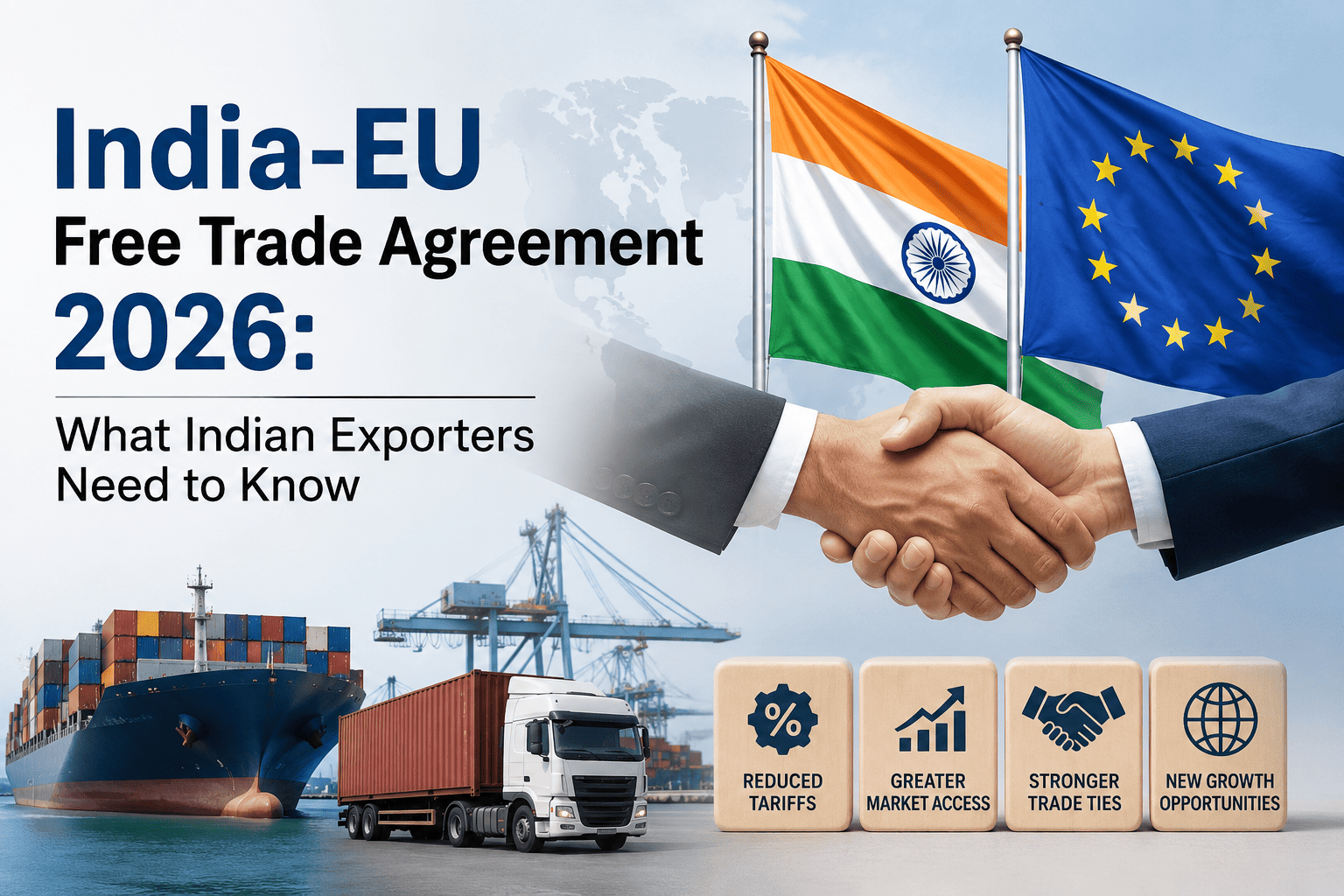
After more than two decades of cease-and-start talks, India and the European Union signed the Free Trade Agreement on January 27 2026. Bilateral trade in goods and services between India and the EU was a staggering EUR186 billion by 2024. The FTA eliminates tariff barriers that have been a hindrance to Indian competition in one of the most prosperous markets. Unlocking the secrets of human behaviour is the scope of the agreement, what sectors are the most benefited and how to take action to take advantage of it today.
What the India-EU FTA Actually Does
The EU will allow the liberalization of 99.5 percent of tariff lines that cover Indian exports. India will eliminate tariffs on 96.6 percent of EU goods in value. Some cuts are effective immediately; others are phased over a period of the course of three or five years. Prior to this deal, EU tariffs on Indian goods ranged between 4% and 26 percent. For the majority of India's labor-intensive export industries, these rates have dropped to zero, the largest tariff-free opening India has achieved with any trading partner.
Sectors That Gain the Most
Textiles and Apparel
This is the biggest victory for Indian exporters. Ready-made clothing, cotton textiles, man-made fibre products, carpets, and handicrafts are exempt from EU taxes under the new agreement. The Ministry of Textiles called it an "transformational deal" for the sector. The timing is important. Indian textile exports to the US have been under intense pressure due to tariffs that once were as high as 50-64 percent. The EU agreement provides a different high-value market, just as American demand slowed.
The EU is already India's second-largest export market for textiles. With no customs access to the market, Indian producers located in Surat, Tirupur, Ludhiana, and Panipat are better positioned to compete with Vietnamese as well as Bangladeshi suppliers that already have advantages in access to European buyers.
Gems and Jewellery
Exports of gems and jewellery to the EU will be subject to zero duty. Analysts from the industry at Nomura estimate that the bilateral trade in this industry could double to about $10 billion when EU buyers receive a no-tariff incentive to source Indian-cut diamonds, gold jewelry and silver artifacts. The Indian gems and jewellery industry employs more than 4.5 million people, with the majority of whom are in the MSME segment. This deal has direct implications for income all over the entire supply chain.
Pharmaceuticals
Indian pharmaceuticals have already benefited by US tariff exemptions and the EU agreement adds the advantage of having access to the market. The EU is an extremely high-value, high-compliance market for active pharmaceutical components. With the removal of tariff barriers and customs procedures streamlined under the new deal, Indian exporters of pharmaceuticals are now better placed to be competitive with European domestic producers on price without sacrificing the status of their regulatory authorities.
Leather, Footwear, and Marine Products
Shoes, leather goods and marine goods are also now exempt from duty under the agreement. For coastal states such as Kerala, Tamil Nadu, and Gujarat, this can be quite significant. Indian exporters of seafood who previously had a difficult time gaining EU access to markets due to the cost of compliance and tariffs now have a level playing field.
Engineering Goods and Chemicals
Engineering products such as base metals, chemicals and plastics are all eligible for significant reductions in tariffs. The precision engineering and automotive parts from India are now more competitive against Chinese as well as Turkish suppliers, which are still facing higher EU tariffs.
What This Means for Indian Exporters on B2B Platforms
EU buyers are currently changing their sourcing strategies. Managers of procurement are searching for authentic Indian suppliers that can demonstrate the quality of their products, conformity documentation and dependable delivery. If you're on a B2B platform like Worldwide Exporter, update your profile by adding three things:
Sector-specific tariff details. EU buyers want to be aware of the tariff classification your goods are a part of and what the FTA impacts their landed cost. A single line indicating FTA zero-duty exemption will make your brand stand out from suppliers who haven't updated their profile.
Documentation for compliance. The EU market has strict requirements for the quality of products, labelling, and origin documents. Suppliers who have ISO certifications as well as test reports and records of the country of origin can convert buyer inquiries at a faster rate than suppliers without.
Clear lead times and capacity for production. EU buyers diversifying away from their existing suppliers need certainty. Indicating your output capacity for the month as well as minimum order quantities as well as standard lead times on your profile will eliminate the friction that leads buyers to change suppliers.
The Competitive Window Is Now
The FTA provides a time-bound advantage. Vietnam, Bangladesh, and Indonesia are watching and are negotiating their own EU agreements. India's zero-duty advantage will diminish as more rivals get advantages in conditions.
Exporters who develop EU relations with buyers in 2026 and 2027 are likely to enjoy the trust of their customers until other suppliers catch up. The gems, textiles, and leather industries have the most narrow windowand Chinese competitors still have to pay MFN tariffs that are standard in the EU and this gives Indian suppliers a significant cost advantage in the present.
Practical Steps for Indian Exporters
Create your product's HTML0 code in the FTA. The preferential tariff only applies if you declare the origin of your product and tariff classification. Make sure to check with DGFT or your Export Promotion Council to confirm the tariff lines that apply and what documentation you'll need.
Make sure you are targeting the right EU markets. Germany, Netherlands, France, Italy, and Belgium are the largest trading partners inside the bloc, each having distinct demand profile. Germany purchases engineering and auto parts; Italy as well as France buy leather and textiles; and the Netherlands manages distribution throughout the bloc.
Create FTA Origin compliance into your documentation starting from the first day. EU customs require evidence of preferential origin. The invoices, packing lists as well as certificates of origin should conform to the correct format. Making sure you have this correct on the first shipment helps build trust among EU buyers and helps avoid costly delays.
Final Thoughts
The Free Trade Agreement between India and the EU is the biggest trade agreement for Indian exporters in the last generation. Free access to the areas of gems, textiles, pharma leather, marine products and engineering products totals 33% of the total annual exports which previously were subject to tariffs up to 26 percent. For exporters of small and medium size this is a major shift, not a slight improvement.
Exporters who act now and improve their profile, ensure they have the correct the right documentation, and then target EU procurement officials directlyand will develop long-lasting EU relationship with customers. The agreement has been signed. The savings in tariffs are real. The next step will depend on how fast Indian exporters arrive.
If you're seeking to connect with verified EU buyers who are ready to buy from India under the new FTA terms, registering your company on an international B2B marketplace like Worldwide Exporter gives you direct access to buyers from all over the world who are looking for Indian suppliers within your product category.