
Vocal for Local to Global: How Indian MSMEs Can Win Real Export Orders in 2026
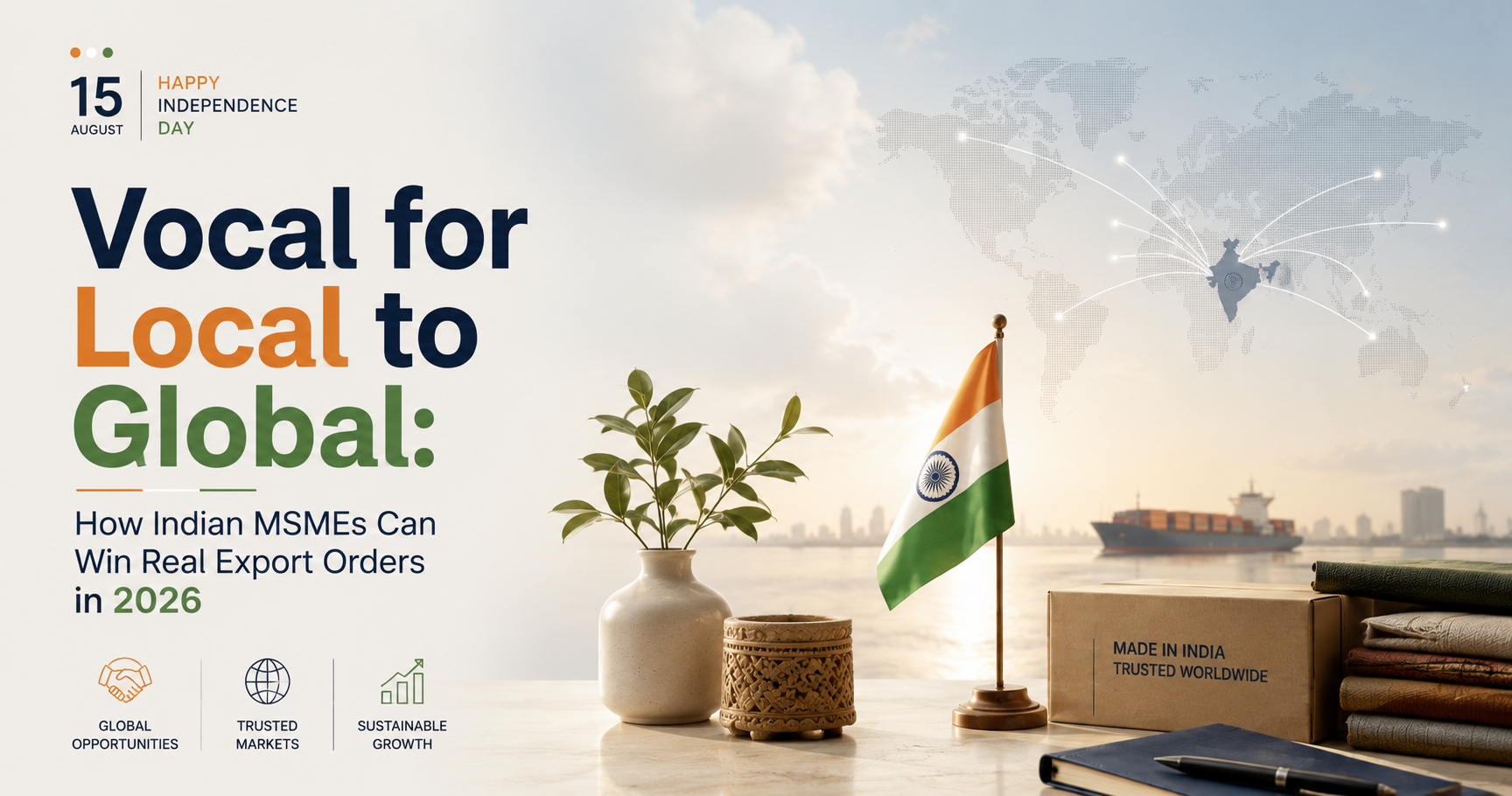
Quick answer: "Vocal for local to global" isn't just an Independence Day slogan — for Indian MSMEs it is a practical export path. By starting with indirect exports or B2B discovery platforms, focusing on one product and one market, and getting export-readiness basics (IEC, GST, quality certificates, documentation) right, a small manufacturer or trader can win real overseas orders in 2026 without an overseas office or heavy capital.
Published: 14 August 2026 · Last reviewed: 14 August 2026
Every 15th of August, the phrase "vocal for local" gets repeated across speeches, posters and social feeds. But for a small business owner in Tirupur, Morbi, Surat or Noida, the more useful question is quieter: how does "local" actually become "global"?
India is marking its 80th Independence Day in 2026, and the "Local to Global" idea has moved from slogan to policy. The Bharatiya Vyapar Mahotsav 2026 — a trade festival held during the Independence Day period and organised by the Confederation of All India Traders (CAIT) — is built explicitly around "Vocal for Local," "Local to Global" and "Atmanirbhar Bharat," and it is aimed squarely at manufacturers, traders, startups, MSMEs, women entrepreneurs and artisans who want to reach international buyers. The momentum is real. What most small exporters lack is a clear, honest playbook.
This guide gives you that playbook — what "local to global" means in 2026, the barriers that trip up first-time exporters, the low-investment ways to start, and, most importantly, how to actually find and verify genuine overseas buyers.
Key Takeaways
- Going global no longer requires an overseas office, huge volumes or a big marketing budget — it requires clarity, discipline and a phased approach.
- The safest entry points are indirect exports and B2B discovery platforms, where you can test demand market-by-market at low cost.
- Finding buyers is only half the job; verifying them protects you from fraud and wasted effort.
- Export-readiness basics — IEC, GST, quality certifications and clean documentation — decide whether your first shipment succeeds or stalls.
- Government schemes like RoDTEP and CGTMSE exist specifically to lower your entry cost. Use them.
What "Local to Global" Really Means for a Small Indian Exporter in 2026
"Local to global" describes a shift in mindset as much as market. It means treating your product not as something you sell within a district or state, but as something an overseas buyer could source from you — reliably, repeatedly, and at a price that competes.
Two things make 2026 a genuinely different year to attempt this.
First, the policy tailwind. The Union government has framed exports as central to the Atmanirbhar Bharat vision, with ambitious national goals. Commerce and Industry Minister Piyush Goyal has set a target of reaching one trillion US dollars in exports this year and two trillion dollars over the next five years, noting that exports had reached around 863 billion dollars — roughly five per cent higher than the previous year. Whether or not those headline numbers are hit on schedule, the direction of policy support is unmistakable.
Second, the practical support has widened. Trade festivals such as the Bharatiya Vyapar Mahotsav 2026 are actively pushing MSMEs toward global buyers, and the government has released new resources — and continued key incentive schemes — aimed squarely at exporters.
Why the Trade-Policy Backdrop Matters Right Now
If you export — or plan to export — to the United States, the tariff environment in 2026 has been unusually volatile, moving through several legal and policy changes in a single year. As of August 2026, many Indian goods entering the US carry an additional duty under recently introduced Section 301 measures, in the region of 10 to 12.5 per cent, layered on top of normal most-favoured-nation rates and any sector-specific duties. That framework is under active legal challenge, so it can shift again.
The takeaway for a small exporter is simple: tariffs and trade rules move, so build flexibility into your pricing and contracts, and always confirm the current duty for your specific product before quoting a foreign buyer. (Our US-tariff textile guide, linked below, goes deeper for garment exporters.)
The Real Barriers That Stop MSMEs From Exporting
When the Commerce Ministry launched its practical export handbook for MSMEs — "Going Global: A Practical Guide for Indian MSMEs," developed by the Centre for Trade and Investment Law at the Indian Institute of Foreign Trade with the Confederation of Indian Industry — it named the barriers that stop small businesses again and again. They are worth stating plainly, because naming them is the first step to solving them:
- Limited access to reliable market information. You don't know which country wants your product, or at what price.
- Difficulty identifying genuine overseas buyers. You can't tell a serious importer from a time-waster — or a fraudster.
- Navigating international standards and certifications. Every market has its own compliance rules, and getting them wrong means rejected shipments.
- Staying price-competitive against larger players. Freight, duties and certification costs can quietly erase your margin.
Notice that two of the four barriers — market information and buyer identification — are fundamentally discovery problems. That is exactly where a modern B2B platform changes the maths for a small seller.
7 Low-Investment Ways to Go From Local Seller to Global Supplier
Across the sellers who succeed, the common thread isn't a bigger budget — it's a narrower focus. The ones who pick one product and one market tend to land a repeat buyer far sooner than those who list everything for everyone. With that in mind, here are seven routes, ordered roughly from lowest to higher commitment, so you can start where you are.
- Start with indirect exports. Supply to export houses or merchant exporters, or become part of a larger company's export supply chain. You carry no foreign-compliance burden and no overseas marketing cost — a safe way to earn export revenue while you learn.
- List on B2B discovery platforms. Digital directories and marketplaces let overseas buyers find you without a sales team abroad. This is the fastest, cheapest way to test demand country by country.
- Focus on one product and one market. Trying to sell everything everywhere multiplies cost and confusion. Choose your most consistent product and one target region, and learn that buyer's expectations deeply.
- Use export promotion council support. Councils offer market exposure, trade connections and export-readiness help at subsidised cost. Join the one that matches your sector (table below).
- Begin with small trial shipments. Overseas buyers often prefer a small first order before committing. Trial shipments reduce working-capital pressure and build buyer confidence while you test your documentation and logistics.
- Replace physical presence with digital credibility. A professional website, a clean digital catalogue with accurate specs and MOQs, prompt email and video communication, and shareable samples do the work an overseas office used to do.
- Explore e-commerce exports. For certain consumer products, online platforms and the DGFT's e-commerce export route let you ship small parcels directly to individual buyers abroad — a lighter model than bulk B2B.
Which Entry Route Fits You? A Quick Comparison
| Entry route | Upfront cost | Risk | Your control | Speed to first order |
|---|---|---|---|---|
| Indirect export (via export house) | Very low | Low | Low | Fast |
| B2B discovery platform / directory | Low | Low–Medium | Medium–High | Medium |
| Direct export (own buyers) | Medium–High | Medium–High | High | Slow |
| E-commerce export (parcels) | Low–Medium | Medium | High | Medium |
Most successful MSME exporters begin at the top of this table and move down as their systems mature — not the other way round.
How to Actually Find and Verify International Buyers
This is the question most guides skip, so let's be specific. Finding a buyer and confirming a buyer are two different skills, and you need both.
Where to Find Overseas Buyers
- B2B discovery platforms and directories. The most scalable option for a small seller. A discovery platform like World Wide Exporter connects Indian MSME exporters and sellers with international buyers across 120+ countries, acting as a discovery layer where your products can be found by buyers actively sourcing from India.
- Trade fairs and buyer-seller meets. Events such as the Bharatiya Vyapar Mahotsav 2026 put you in front of B2B delegates and international buyers in person. Council-organised buyer-seller meets are especially valuable for first-timers.
- Export promotion councils. Councils run trade delegations and share buyer leads for their sector.
One pattern is consistent on discovery platforms: the seller profiles that convert enquiries fastest are rarely the cheapest — they're the ones with a complete catalogue, clear MOQs, and a same-day reply habit. Buyers sourcing from India for the first time are reducing their own risk, and completeness reads as reliability.
Match Your Sector to the Right Export Promotion Council
| Your product sector | Relevant export promotion body |
|---|---|
| Agricultural & processed food products | APEDA |
| Spices | Spices Board India |
| Engineering goods | EEPC India |
| Gems & jewellery | GJEPC |
| Apparel / made-ups | AEPC |
| Cotton textiles | Texprocil |
| Chemicals | Chemexcil |
| Cross-sector / overall support | FIEO (Federation of Indian Export Organisations) |
How to Verify a Buyer Before You Commit
An unverified "buyer" can cost you a shipment, a certification, or worse. Before you invest in a first order, run these checks:
- Confirm the company exists independently. Look for a real website, a business registration in their country, and a consistent trading history — not just a free email address.
- Watch the payment terms. Genuine buyers accept standard, secure terms. Pressure to skip escrow, advance verification or a letter of credit is a red flag.
- Start small and test. A trial order reveals more about a buyer's seriousness than any amount of correspondence.
- Prefer platforms with verification signals. Directories that verify buyers reduce your exposure before you ever ship.
Trust runs in both directions. Foreign buyers dealing with an Indian supplier for the first time are also checking you — which is why a verifiable, credible online presence converts enquiries into orders. (If you're curious how buyers should verify a platform itself, our guide on verifying World Wide Exporter walks through the trust signals to look for.)
A note on how we fit in: World Wide Exporter is a B2B trade discovery platform — a directory and discovery layer that connects verified international buyers with Indian sellers. It does not handle payments or shipments; those stay between you and your buyer, using standard trade instruments. Think of it as the place your product gets found, not a freight or payment service.
Your Export Readiness Checklist Before the First Shipment
Low investment does not mean low preparation. Tick these before you accept an overseas order:
- Importer-Exporter Code (IEC) from DGFT — mandatory for exporting from India.
- GST registration and a clean invoicing process, so you can claim eligible refunds.
- Product quality certifications required by your target market (standards, testing, and — for food/agri — residue and safety compliance).
- Complete, accurate export documentation — commercial invoice, packing list, and any certificates of origin your FTA benefits depend on.
- Clear Incoterms and currency. Agree whether you're quoting EXW, FOB, CIF, etc., and in which currency (USD, EUR, GBP). Never quote blindly.
- Costed pricing. Include freight, duties, taxes and certification costs before you set a number.
- Working-capital plan. Export cycles are longer than domestic sales; plan for delayed payments and shipping timelines.
Government Schemes That Lower Your Entry Cost in 2026
The government has built specific support to reduce first-time exporters' costs and risk. The two most relevant to a small exporter this year:
- RoDTEP (Remission of Duties and Taxes on Exported Products). Refunds embedded, non-creditable central, state and local taxes on exported goods, improving your price competitiveness. It remains active, extended by DGFT Notification 74/2025-26 (dated 31 March 2026) and currently in force through 30 September 2026 at the existing rate schedule. Rates are notified per eight-digit HS code — roughly 0.3% to 4.3% of FOB value, with per-unit value caps — so always look up your exact line in the DGFT RoDTEP schedule rather than assuming a rate. Textile note: apparel exporters are often better served by RoSCTL than RoDTEP for the same product line — compare both for your HS code.
- CGTMSE (Credit Guarantee Fund Trust for Micro and Small Enterprises). Enables collateral-free working-capital and term loans. From 1 April 2025 the guarantee ceiling was raised to ₹10 crore for standard micro and small enterprises (up to ₹20 crore for DPIIT-recognised startups under the separate CGSS), and the annual guarantee fee was cut to 0.37% per annum. The guarantee protects the lender, and you apply through a member lending institution, not to CGTMSE directly.
Beyond these, first-time exporters can tap Districts as Export Hubs (DEH) for local training and marketing support, the DGFT's Niryat Bandhu mentorship programme, and the DGFT E-Commerce Export Handbook for selling online. For a fuller breakdown, see our complete list of government schemes for MSME exporters in India (2026), linked at the end.
Scheme rates and ceilings change by official notification — confirm the current figure for your case on the DGFT and CGTMSE portals before you rely on it.
What "Vocal for Local" Success Signals Teach MSMEs
You don't need a celebrated brand story to learn the pattern behind successful "local to global" journeys. Look at how consumer and craft brands scaled from Indian origins to global shelves, and the same signals repeat:
- They started with a focused product and got its quality relentlessly consistent before scaling.
- They invested early in credibility — clear branding, honest specs and a professional presence — because a buyer's first "factory visit" is usually your website.
- They treated the first overseas buyer as a relationship, not a transaction, and let repeat orders compound.
The lesson isn't "go big." It's "get one thing right, repeatedly, for the right buyer."
Common Mistakes to Avoid
- Exporting without market research. Shipping to a country you haven't studied is guessing, not exporting.
- Accepting a large order beyond your capacity. A missed deadline on your first big order can end the relationship.
- Ignoring or misunderstanding payment terms. This is where small exporters lose money most often.
- Expanding across many countries at once. Depth beats breadth early on.
- Mixing domestic and export finances. Keep them separate for cleaner accounting and cash-flow visibility.
- Quoting a price before confirming the current duty. In a volatile tariff year, an old number can wipe out your margin.
Expert Tips From the Field
- Write your catalogue for a stranger abroad, not a neighbour. Spell out specs, MOQs, lead times and packaging — assume no shared context.
- Reply fast. On discovery platforms, response speed is a ranking and conversion factor as much as price.
- Build a duty-flex clause into contracts that deliver months ahead, so a tariff change doesn't become your loss.
- Collect proof. Certifications, verified badges and consistent reviews are the digital equivalent of a firm handshake.
Frequently Asked Questions
Can a small MSME start exporting without large capital?
Yes. Many MSMEs begin with indirect exports or small orders through B2B discovery platforms, which need minimal upfront investment.
Do I need an overseas office to export from India?
No. Most first-time exporting today is managed digitally — through online catalogues, email and video calls — without any foreign office.
What is the very first legal requirement to export from India?
An Importer-Exporter Code (IEC) from the DGFT is mandatory. GST registration and product-specific certifications typically follow.
How do I find genuine international buyers?
Through B2B discovery platforms and directories, sector-specific export promotion councils, and trade fairs and buyer-seller meets. Always verify a buyer before committing to a large order.
How do I know a buyer isn't a fraud?
Confirm the company exists independently, insist on standard secure payment terms, start with a small trial order, and favour platforms that verify buyers.
What does "vocal for local to global" mean for my business?
It's the shift from selling only in local markets to positioning your product for overseas buyers — using low-cost digital channels, government support and phased scaling.
Is the RoDTEP scheme still available in 2026?
Yes. RoDTEP was extended by DGFT and is in force through 30 September 2026 at existing rates. Rates are set per HS code, so check your exact product line in the DGFT schedule, and confirm the next extension before you file.
How much collateral-free loan can an MSME get under CGTMSE?
Since 1 April 2025, the CGTMSE guarantee ceiling is ₹10 crore for standard micro and small enterprises, and up to ₹20 crore for DPIIT-recognised startups under CGSS. You apply through a member lending institution.
How much should I export in my first order?
Start small. A trial shipment tests your documentation, logistics and the buyer's seriousness while keeping working-capital pressure low.
Which export promotion council should I join?
It depends on your product — for example, APEDA for agri and processed foods, EEPC for engineering goods, GJEPC for gems and jewellery, AEPC for apparel, with FIEO for cross-sector support.
How long before I see results from exporting?
Expect gradual growth rather than instant returns. Building buyer trust and repeat orders takes time, which is why a focused, phased approach works best.
Do US tariffs affect whether I should export there?
They affect your landed cost and pricing, and the 2026 tariff situation has been volatile. Always confirm the current duty for your specific product before quoting a US buyer.
Can service-based MSMEs also go global?
Yes. Digital services can be delivered internationally with even lower investment than physical goods.
Conclusion: Turn the Slogan Into an Order Book
"Vocal for local to global" only means something when a local product actually reaches a global buyer. In 2026, the ingredients are in place — policy support, active incentive schemes like RoDTEP and CGTMSE, and discovery platforms that put small Indian sellers in front of international buyers. What's left is execution: get export-ready, start focused and small, verify who you deal with, and let repeat orders compound.
An honest caveat: going global isn't right for every MSME right now. If your cash flow can't absorb a 60–90 day payment cycle, or your capacity can't hold quality at higher volume, it's often smarter to build domestic strength first. And in sectors facing steep duties in a key market, the maths may not work this year — which is exactly why you confirm current tariffs before committing. A discovery platform widens your reach; it doesn't replace your own due diligence.
Ready to be found by verified international buyers? List your products on World Wide Exporter and turn your local strength into global orders — this Independence Day and beyond.