
India-UK Trade Deal 2026: What Every Indian Exporter Must Know Today
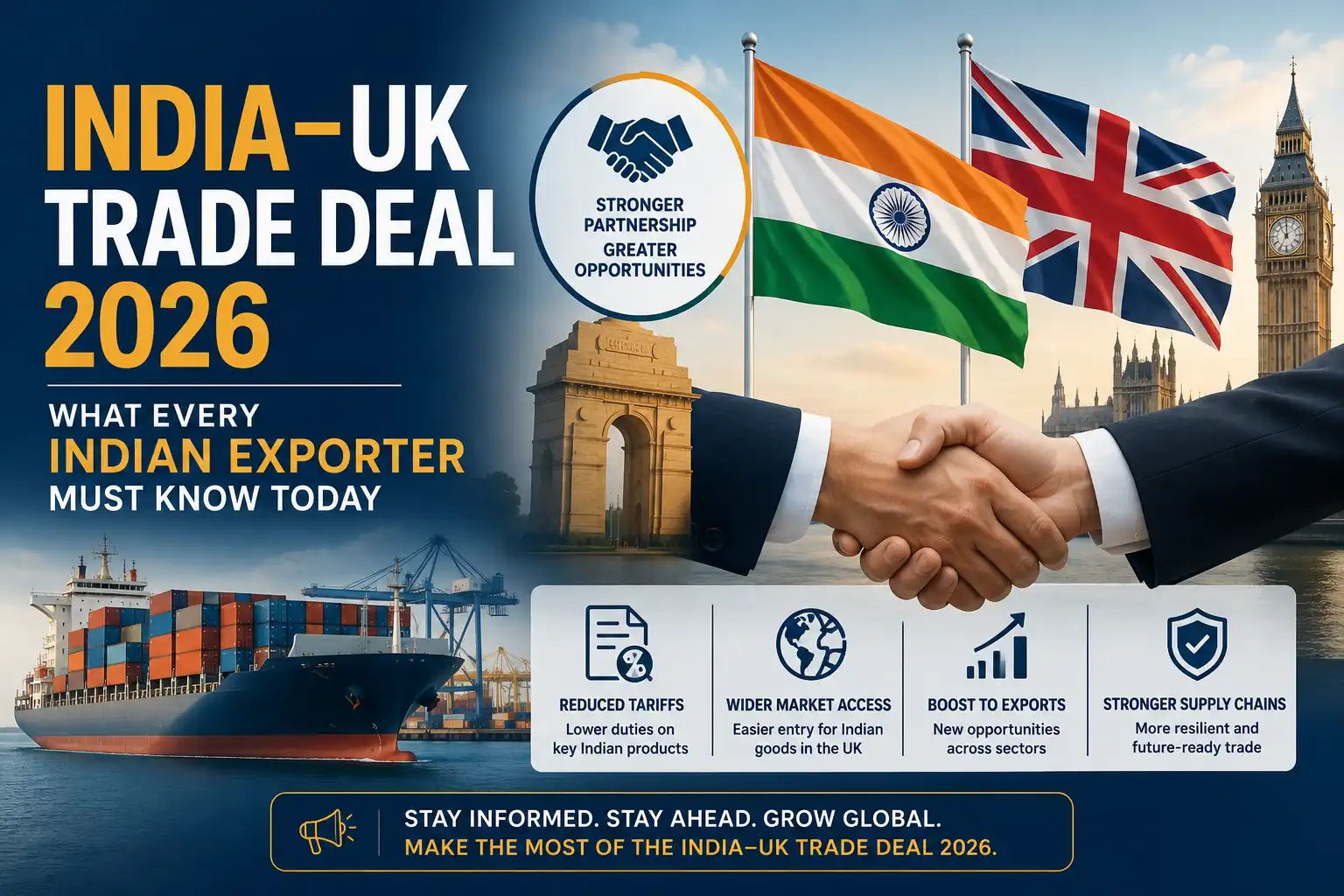
Today, July 15, 2026, the India-UK Comprehensive Economic and Trade Agreement (CETA) is no longer in the negotiation stage. It's now in force.
CETA now allows Indian exporters duty-free access to the UK for 99% of UK imports. In the bilateral trade, the UK has removed tariffs on 96.8% of its tariff lines, affecting 97.7% of trade. Post-CETA, many tariffs are now 0%, like those on processed food (previously 70%), marine products (21.5%), engineering goods (18%), leather and footwear (16%), and textiles and clothing (12%).
This is the first India-Western country bilateral trade deal. The previous India trade deal with the EFTA was a multilateral deal. CETA is bilateral.
CETA is a trade deal focused on textiles, leather, gems and jewelry, engineering goods, marine products, chemicals, processed foods, MSMEs, and farming. It is expected to benefit farmers and manufacturers.
This article focuses on you, the exporter to the UK, or those of you who plan to export to the UK.
CETA Benefits: The Numbers
Before CETA, Indian goods to the UK were subject to standard MFN tariffs. As a result, UK priced Indian goods were more expensive than those from countries with preferential access to the UK. Indian exporters also did not have duty-free access to UK imports for garments, while both Bangladesh and Pakistan did.
Since July 15, 2026, the UK has almost fully removed tariffs, impacting 97.7% of UK-India trade. Complete duty elimination includes textiles, apparel, leather and footwear, marine products, gems and jewellery, engineering goods, auto components, chemicals, and processed foods.
Tariffs have been removed or reduced in India on 90% of UK tariff lines and 64% have become duty free at once. UK-India bilateral trade was £48 billion in 2025. It will increase by £25.5 billion per year at once with the agreement, and it is expected to grow India's GDP by £5.1 billion and the UK's by £4.8 billion per year.
Which Indian Export Sectors Gain Advantage?
Textiles and Apparel
Before the agreement, Indian textiles that entered the UK had tariffs of up to 12%, while textiles from Bangladesh and Pakistan entered duty free. This trade imbalance is now resolved.
Tirupur, Surat, and Ludhiana manufacturers are now competing in the UK on the same terms. Indian companies, like Welspun Living, that make textiles, already have UK customers and will have greater profits with the agreement.
Leather and Footwear
Tariffs on Indian leather goods and footwear that were as high as 16% now have zero tariffs. Tamil Nadu, which has a majority of India's exports of leather, has the biggest advantage, along with Agra, which has Indian footwear manufacturing. A 16% tariff is now a margin gain to every UK order.
Marine Products
Tariffs on Indian marine products that contain fish, shrimp, prawns, squid, and processed seafood drop from 21.5% to 0. The UK is a large buyer of Indian marine products, and India is the largest exporter of shrimp in the world. The removal of the 21.5% tariff changes the pricing dynamics for UK seafood importers looking to India in comparison to other suppliers.
Andhra Pradesh, Gujarat, Kerala, and Tamil Nadu lead Indian marine exports. For exporters in these states, the change in tariffs is now a direct commercial benefit for every export since this morning.
Engineering Goods and Auto Components
Tariffs of up to 18% on Indian engineering goods and auto components are eliminated. Indian exporters of precision engineering from Chennai, Pune, and Coimbatore now have the ability to compete with European goods in the UK with no tariff disadvantage.
Processed Foods
Of all the tariffs, this is the largest reduction in percentage, from 70% to 0 for Indian processed food products. The UK has a significant South Asian population and a high demand for Indian food products. Before the removal of the 70% tariff, many food products were not commercially viable to export. With the removal of this high tariff, there is a direct route for exporters of spice, ready meals, pickles, chutneys and specialty foods to UK retail and food service.
For processed food products, 97.1% of the tariff lines will now allow duty-free entry. With a global import market of over $90 billion, the UK has a large agricultural import market and India can now compete with no tariffs.
Gems and Jewelry
Effective immediately, there is no duty on gems and jewelry in the U.K. India is home to a majority of the world's polishing and cutting services for diamonds and exports a considerable amount of gold and silver goods. Exporters in Surat, Mumbai, and Jaipur will benefit directly from this.
What the CETA Means for MSMEs Specifically
PM Modi mentioned that CETA would provide a "new momentum to farmers, entrepreneurs, and MSMEs." The agreement has provisions for SMEs, simplified customs, and digitization of trade.
The Double Contribution Convention, which will be enacted with CETA today, will exempt Indian employees who are temporarily working in the U.K. from double social security contributions for up to five years. This will positively impact more than 75,000 Indian employees and more than 900 companies.
For MSME goods exporters, zero customs and simplified customs is the opportunity that did not exist yesterday. A brassware manufacturer in Moradabad, a leather goods exporter in Kanpur, or a spice processor in Kerala can now offer competitive quotations to U.K. buyers, which was not possible when custom duties of 12%, 16%, or 70% were applicable to each shipment.
How to Claim Zero Duty on Your U.K. Exports: A Practical Guide
Tariff elimination is automatic from today, but exporters must have the right documents to claim the zero customs duties for U.K. imports.
Step 1: Check the CETA tariff classification for your product. You need to determine what tariff line your product falls under and whether it is in the CETA Schedule of Concessions. The U.K. Trade Tariff at gov.uk/trade-tariff will provide the preferential customs rates for each HS code in the India-U.K. Agreement.
Step 2: Confirm that your product adheres to the Rules of Origin. CETA preferential tariffs can only be applied to goods originating from India based on the agreement's Rules of Origin. Your product must be manufactured in India with a certain level of value addition. This level varies with different product categories. You can obtain the relevant information regarding your product's category from either your Export Promotion Council or from the DGFT.
Step 3: Make arrangements for your origin documents. To avail of the preferential tariff, you must possess either a Movement Certificate EUR.1, as certified by Indian Customs, or an origin declaration in your commercial invoice for shipments that fall below the specified value. Your customs agent/freight forwarder can assist you with the required formats.
Step 4: Revise your commercial invoice. The invoice should indicate the country of origin as India and the corresponding origin declaration wording as per the CETA agreement. Poor or missing documents will result in UK customs applying the standard MFN rate instead of the CETA preferential rate.
Step 5: If needed, register on relevant UK trade systems. UK importers wishing to claim CETA preferences must register with HMRC through the Origin Registration portal at gov.uk. You should encourage your regular UK customers to immediately complete this registration in order to obtain preferential tariff treatment on your exports.
Final Thoughts
CETA is operational as of today, July 15, 2026. For Indian exporters in textiles, leather, marine products, processed food, engineering goods, gems, and chemicals, the CETA agreement has immediately impacted the UK market for your products.
By correctly preparing their origin documentation and promptly approaching UK buyers, exporters will immediately win business that competitors will miss. Go to worldwidexporter.com to engage with Verified UK buyers looking for Indian suppliers.
Pressing Questions
When did the Trade Agreement go into effect? On the 15th of July 2026, the India-UK Comprehensive Economic and Trading Agreement (CETA) was officially signed.
What Indian Export Industries Benefit The Most Benefits from the India-UK FTA? Industries like leather, textiles, apparel and footwear seafood and products from fish, processed food jewelry and gems, automobile components, engineering and other chemicals will have UK tariffs eliminated or significantly decreased from the 15th July 2026.
Do Indian Exporters get Zero Duty on All UK Exports from Now? The UK has removed tariffs on 96.8% of its tariff lines, covering 97.7% of the total trade with India. 99% of Indian exports, by tariff line, will have duty-free access. Certain exclusions or phased implementation may apply.
What do Indian Exporters Need to Obtain CETA Preferred Tariffs? CETA preferred tariffs require origin documentation in the form of a Movement Certificate EUR.1 or an origin declaration on the commercial invoice. UK importers will register with HMRC's Origin Registration.
What are the India-UK CETA and India-EU FTA trade agreements like? The India-EU FTA started in January 2026 and removed tariffs for nearly all Indian goods to be exported to the EU. The India-UK CETA started today and covers nearly all goods exported to the UK. Since the agreements started at the same time, Indian exporters will be able to access both the EU and UK markets simultaneously for the first time.