
Green Chilli Export From India: The Complete Exporters Guide
Key takeaways
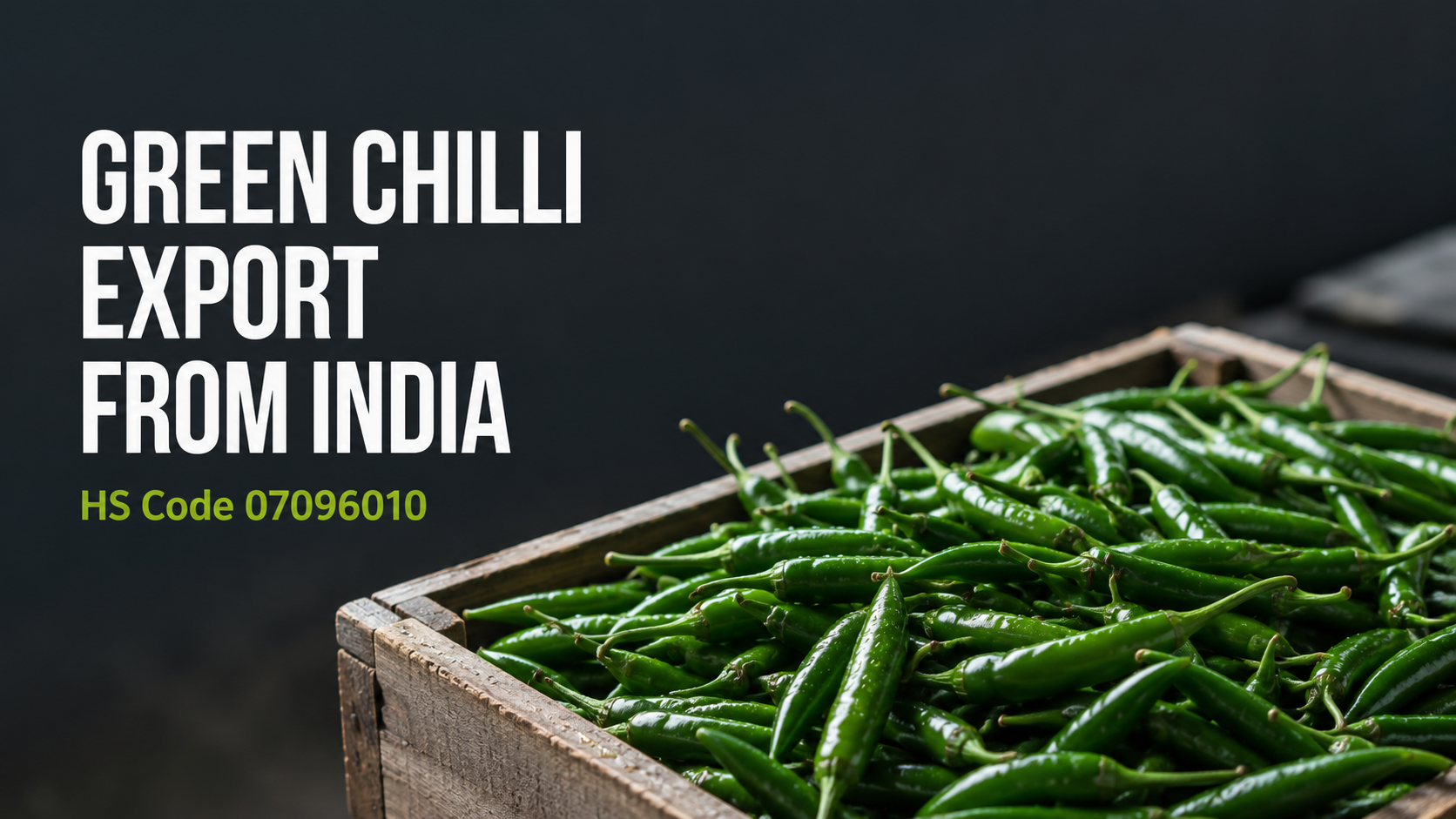
- India ships fresh green chilli under HS Code 07096010 ("Green chilly," within heading 0709 — other vegetables, fresh or chilled).
- G4 (Guntur Sannam) dominates export volumes because its thicker skin survives transit; Jwala serves diaspora and pickling demand.
- You need an IEC from DGFT, an APEDA RCMC, and a Phytosanitary Certificate issued through the PQIS portal before your first consignment moves.
- The Gulf is the volume market; the EU and UK are the margin markets — and the ones where a pesticide residue failure will cost you the container.
- Realistic shelf life with an unbroken cold chain is roughly 15–25 days, which is what makes the air-versus-sea decision the single most important commercial call you'll make.
Walk through the Guntur mirchi yard at six in the morning and you'll understand something about this trade that no spreadsheet will teach you. The sorting happens by hand. Two women can look at the same crate and disagree about whether the pods make export grade, and one of them will be right, and the difference between them is about four rupees a kilo and, occasionally, an entire rejected container in Jebel Ali three weeks later.
That's the honest version of green chilli export from India. It is a genuinely good business — India's position as a chilli-producing country is unmatched, the buyer base in the Gulf is deep and repeat-heavy, and the compliance barrier is low enough for a serious newcomer to clear. It's also a business where perishability, pesticide residue limits and cold-chain discipline decide who is still trading in year three.
This guide covers what actually matters: the varieties, the paperwork, the packing, the pricing logic and the failure modes.
Why India dominates the green chilli trade
India grows chilli across an unusually wide span of agro-climatic zones — Andhra Pradesh, Telangana, Karnataka, Maharashtra, Gujarat, Tamil Nadu, Madhya Pradesh, West Bengal. Staggered planting across those states is why an Indian supplier can quote fresh green chilli almost year-round while single-region origins go dark for months.
Three structural advantages compound:
Volume and price floor. Domestic consumption is enormous, which means the crop gets planted regardless of export demand. Exporters draw from a deep pool rather than contracting scarce specialist acreage.
Varietal range. Buyers who want heat, buyers who want colour and buyers who want a specific pod length can all be served from the same origin.
Established freight lanes. Air corridors from Hyderabad, Chennai, Mumbai and Bengaluru into the Gulf, plus reefer sea routes from Nhava Sheva, Mundra and Chennai, are mature and competitively priced.
Which green chilli varieties are actually exported?
This is the question that separates people who have shipped from people who have read about shipping. Variety is not a preference — it's a specification, and getting it wrong produces a technically compliant container full of chillies your buyer cannot sell.
G4 / Guntur Sannam — the export workhorse
Also traded as Eagle 151. Dark green, glossy, firm, uniform pods with noticeably thick skin. That skin is the entire commercial argument: it resists moisture loss and handling damage, which is what makes reefer sea freight viable at all. Sharp, high pungency. This is the chilli sitting on shelves in Dubai and Doha.
Best for: GCC retail and wholesale, Southeast Asia, food processors wanting consistent heat.
Jwala — the diaspora favourite
Pale green, slender, slightly wrinkled skin, thinner-walled. "Jwala" means volcano, and it earns the name — but the heat has a different, more aromatic character than G4's flat bite. Thinner skin means shorter shelf life and more transit sensitivity.
Best for: UK and diaspora-heavy retail, pickling, hot sauce production, air freight lanes.
G4 vs Jwala: comparison
| Attribute | G4 / Guntur Sannam | Jwala |
|---|---|---|
| Colour | Dark green, glossy | Pale / light green |
| Skin | Thick, smooth | Thinner, slightly wrinkled |
| Pungency | High, sharp | Moderate–high, aromatic |
| Transit durability | Excellent | Moderate |
| Typical shelf life (cold chain) | ~15–25 days | Shorter; air freight preferred |
| Primary markets | UAE, Saudi, Qatar, Kuwait, Bahrain, Oman | UK, diaspora retail, processing |
| Sea freight suitable? | Yes, on short/medium lanes | Marginal — assess lane by lane |
Shelf-life ranges reflect commonly quoted trade practice under proper pre-cooling and unbroken cold chain. Validate against your own lane performance.
An observation from the yard
Buyers routinely specify "green chilli" with no variety named, then reject on appearance. Put the variety, the pod length range, the colour and the defect tolerance in the proforma invoice, in writing, before the first shipment. A five-line specification block has prevented more disputes in this trade than any contract clause.
HS code and product classification
Fresh green chilli exports from India move under:
| Level | Code | Description |
|---|---|---|
| Chapter | 07 | Edible vegetables and certain roots and tubers |
| Heading | 0709 | Other vegetables, fresh or chilled |
| Indian tariff item | 07096010 | Green chilly |
Related codes you may encounter: dried chilli and chilli powder fall under Chapter 09 (spices) rather than Chapter 07, which changes your regulatory pathway — the Spices Board becomes relevant alongside APEDA. Classify carefully. An incorrect HS code affects duty treatment, export incentive eligibility and your buyer's import clearance.
Practical tip: ask your buyer to confirm the tariff line their customs authority expects on their side. Indian eight-digit codes and destination-country codes diverge beyond the first six digits.
Green chilli export procedure from India, step by step
Step 1 — Import Export Code (IEC)
Issued by the DGFT. Fully online, PAN-linked, one per business entity. Nothing moves without it. This is your first application, not your second.
Step 2 — APEDA registration (RCMC)
Fresh vegetables are scheduled products under the APEDA Act, 1985, so an RCMC from APEDA is mandatory before your first export consignment. Applications are online and require a valid IEC. Registration also opens access to APEDA's transport-assistance and market-development schemes — genuinely useful for a perishable product where airfreight is a large cost line.
Step 3 — Phytosanitary Certificate (PSC)
This is the one that catches first-time exporters.
India's NPPO obligations flow from the International Plant Protection Convention. The certificate is issued by Plant Quarantine and Inspection Services (PQIS) under the Directorate of Plant Protection, Quarantine & Storage, Ministry of Agriculture & Farmers Welfare, and applications run through the PQIS online portal.
What matters operationally:
- Apply 2–3 days before shipment for a normal consignment.
- A quarantine officer physically inspects the consignment; the certificate is issued only if it's free of quarantine pests.
- For perishable consignments the PSC validity is generally limited to about 7 days (30 days for non-perishables) — so the certificate and the vessel or flight must be tightly sequenced. Get this wrong and you re-inspect.
- Importing-country requirements sit on top of Indian requirements. Always confirm the destination NPPO's specific declarations before you book.
Step 4 — FSSAI and food-safety compliance
Registration or licence as applicable to your operation. Buyers in the EU and UK will additionally expect HACCP, and increasingly GlobalG.A.P. certification at farm level.
Step 5 — Residue testing
Covered in detail below. Do not treat this as optional paperwork.
Step 6 — Shipping documentation
Commercial invoice, packing list, Bill of Lading or Airway Bill, Certificate of Origin, Phytosanitary Certificate, Certificate of Analysis (where the buyer requires it), insurance certificate, and the shipping bill filed on ICEGATE.
You'll also need AD Code registration with your bank at the port of export and ICEGATE registration for customs filing.
The risk nobody writes about: pesticide MRLs
Here is the part of green chilli export from India that ranking articles skip, and it's the part that ends businesses.
The EU sets maximum residue levels for pesticides under Regulation (EC) No 396/2005. Products exceeding those levels are removed from the European market. Border rejections are logged in the Rapid Alert System for Food and Feed (RASFF) — and published analysis of RASFF data has repeatedly identified India as a leading country of origin for pesticide-residue notifications in chilli.
Translated into commercial reality: a container that fails at a European port is typically destroyed or refused entry, at your cost, plus freight, plus the relationship.
How serious exporters handle it:
- Contract farming with documented spray schedules. You cannot manage residues you cannot trace. Buy from an open mandi and you are gambling.
- Pre-shipment lab testing against the destination market's MRL list — not India's. EU limits are frequently stricter, and default MRLs apply to substances with no specific entry.
- Know the banned list per market. A pesticide legally used in India may be prohibited outright in your destination.
- Maintain the Certificate of Analysis per batch. Buyers increasingly demand it, and it's your defence if a dispute arises.
- Treat GCC and EU as different products commercially. Same chilli, different assurance cost. Price accordingly.
Expert tip: if you are new to this trade, start in the Gulf, build cash flow and process discipline, and enter the EU only once your residue testing regime is boring and routine. Exporters who reverse that order tend not to get a second attempt.
Packing and cold chain
Green chilli is a living, respiring product. Everything below exists to slow it down.
Typical export packing specification
| Element | Common practice |
|---|---|
| Primary pack | Ventilated corrugated fibreboard box (CFB) |
| Net weight | Commonly 5 kg or 10 kg per carton (buyer-specified) |
| Liner | Perforated polyethylene, or vented insert |
| Ventilation | Side and end vents — non-negotiable for respiration heat |
| Palletisation | Stretch-wrapped, corner-boarded, with vertical airflow channels preserved |
| Labelling | Product, variety, grade, net weight, packhouse code, lot number, origin, exporter details, buyer-required marks |
Confirm exact carton dimensions and count against your buyer's spec and your reefer's pallet configuration. These vary by market.
The cold chain sequence
- Harvest early morning, when field heat is lowest.
- Pre-cool immediately. This is the step most first-time exporters skip and the reason most of their first containers arrive tired. Removing field heat fast is worth more than any downstream intervention.
- Grade and pack in a temperature-controlled packhouse.
- Maintain the correct temperature band through storage and transit. Chilling injury is real — over-cooling causes pitting and water-soaked lesions that buyers reject.
- Reefer set point confirmed and logged before the doors close. Photograph the display.
- Temperature data logger in the consignment. Cheap. Ends arguments.
Air freight vs sea freight
| Factor | Air freight | Sea (reefer) |
|---|---|---|
| Transit time | 1–3 days | 5–20+ days by lane |
| Cost per kg | High | Substantially lower |
| Arrival quality | Excellent | Good with correct pre-cooling |
| Minimum viable volume | Low — good for trial orders | Full container economics |
| Best fit | EU/UK, Jwala, premium retail, new buyers | GCC, G4, established repeat volume |
The decision rule: if the lane transit plus buyer shelf-life requirement exceeds roughly 60–70% of realistic product shelf life, fly it. The freight saving on sea evaporates the moment you take a claim.
Expert tip: send trial orders by air even when you intend to ship by sea. Get the buyer's approval on product quality first, isolate the variable, then optimise freight. Combining a new buyer, a new lane and a cost experiment in one shipment is how people learn expensive lessons.
Green chilli export price: how it's actually built
Buyers search for a per-kilo number constantly, and almost nobody answers honestly. Here's the honest answer: anyone quoting you a fixed per-kg export price without knowing your destination, Incoterm, variety, grade and month is guessing.
What you can do is understand the stack.
The cost stack
| Component | Notes |
|---|---|
| Farmgate / mandi price | The volatile input. Swings hard with harvest, rainfall and domestic demand. |
| Grading & rejection loss | Export-grade recovery from a raw lot is materially below 100%. Budget it explicitly. |
| Packhouse, pre-cooling, packing materials | Per-kg, reasonably stable |
| Certification & testing | PSC fees, residue testing, COA |
| Inland transport to port/airport | Reefer truck |
| Terminal handling, customs, documentation | Per shipment |
| Freight | The big variable — air vs sea changes everything |
| Insurance | If CIF |
| Margin | Yours |
Why quotes differ so wildly
- Incoterm. An FOB Chennai quote and a CIF Jebel Ali quote are not comparable numbers, and buyers conflate them constantly.
- Season. Peak harvest (roughly December–March) softens farmgate prices; lean months tighten them sharply.
- Grade. Export grade, premium export grade and "commercial" grade are three different products.
- Volume and payment terms. Advance payment, against LC, and 30-day credit are three different prices.
Practical advice for importers: ask for the quote broken into FOB + freight + insurance. Any exporter unwilling to show you that split is hiding something, and it's usually not in your favour.
Top export markets for Indian green chilli
The Gulf — volume and reliability. UAE, Saudi Arabia, Qatar, Kuwait, Bahrain and Oman are the backbone. Short transit, large South Asian populations, well-established distribution. G4 is the expected variety. Dubai in particular functions as a re-export hub into wider regional markets.
United Kingdom — quality-driven. Strong diaspora demand, retail buyers with real specification discipline, and post-Brexit requirements that are now distinct from the EU's. Verify UK-specific plant health and residue requirements separately — do not assume EU rules apply.
European Union — highest margin, highest bar. Worth entering only with a mature residue-control regime.
Southeast Asia — growing. Malaysia, Singapore, Sri Lanka. Competitive on price with regional origins.
Other markets appearing in Indian export records include Canada, Maldives and various Nordic and Central European destinations, generally at lower volumes.
Common mistakes that cost exporters money
- Skipping pre-cooling. Everything downstream fails if field heat stays in the box.
- Sourcing from open mandis for EU-bound shipments. No traceability, no residue control, no defence.
- Vague product specification. "Good quality green chilli" is not a specification.
- Mismatching PSC timing to sailing dates. A 7-day perishable certificate and a delayed vessel means re-inspection.
- Quoting CIF while thinking FOB. Margin disappears into freight.
- Over-cooling. Chilling injury looks like buyer-side mishandling but it's yours.
- Ignoring destination-specific declarations. Some importing NPPOs require additional declarations on the PSC. Confirm before booking.
- Scaling too fast after one good container. One successful shipment proves the lane worked once.
How World Wide Exporter approaches it
We work the parts of this chain that determine whether the container clears: sourcing from farms with documented spray records, pre-cooling within hours of harvest, grading to a written specification the buyer signs off before we pack, and residue testing against the destination market's limits rather than India's. We'd rather lose an order at the quoting stage than lose a buyer at the port.
If you're sourcing fresh green chilli — G4, Jwala or a specification of your own — request a quote and a product specification sheet and we'll come back with an FOB and CIF split, current lead times, and a trial-order proposal sized to your lane.
Frequently asked questions
What is the HS code for green chilli export from India?
Fresh green chilli is exported under Indian tariff item 07096010, within heading 0709 (other vegetables, fresh or chilled), Chapter 07. Dried chilli and chilli powder fall under Chapter 09 instead.
What licences do I need to export green chilli from India?
An IEC from DGFT, an APEDA RCMC (fresh vegetables are scheduled products), a Phytosanitary Certificate via the PQIS portal for each consignment, and FSSAI registration or licence as applicable. AD Code and ICEGATE registration are also needed operationally.
Is APEDA registration mandatory for green chilli export?
Yes. Fresh vegetables are scheduled products under the APEDA Act, 1985, so the RCMC is required before your first export consignment. A valid IEC is a prerequisite for the application.
Which green chilli variety is best for export?
G4 (Guntur Sannam) for most export lanes — thick skin, glossy dark green, high pungency, good transit durability. Jwala where the buyer wants the lighter, aromatic profile, typically for diaspora retail and pickling.
What is the shelf life of exported green chilli?
Commonly quoted trade practice is roughly 15 to 25 days for G4 under proper pre-cooling and an unbroken cold chain. Jwala is shorter. Actual performance depends on harvest maturity, pre-cooling speed and transit temperature control.
Which countries import green chilli from India?
The Gulf states lead by volume — UAE, Saudi Arabia, Qatar, Kuwait, Bahrain, Oman — followed by the UK, EU markets and parts of Southeast Asia.
How much does green chilli export cost per kg?
There's no single figure. Price depends on variety, grade, season, destination, Incoterm and volume. Always ask for quotes split into FOB, freight and insurance so you can compare like with like.
What is a Phytosanitary Certificate and who issues it?
An official certificate confirming a consignment meets the importing country's plant health requirements. In India it's issued by Plant Quarantine and Inspection Services under DPPQS, applied for through the PQIS portal.
How long is a Phytosanitary Certificate valid?
For perishable consignments, validity is generally limited to around 7 days (about 30 days for non-perishables), so the certificate must be tightly sequenced with the actual shipment date. Confirm current rules on the PQIS portal.
Can green chilli be exported by sea?
Yes — G4 in particular ships well in reefer containers on short and medium lanes, provided pre-cooling is done properly. Longer lanes and thinner-skinned varieties usually justify air freight.
What temperature should green chilli be shipped at?
Fresh green chilli is chilling-sensitive and needs a relatively narrow temperature band — too cold causes pitting and water-soaked lesions. Confirm the exact set point with your packhouse technologist for your variety and lane.
Why do green chilli shipments get rejected in the EU?
Most often pesticide residues exceeding limits under Regulation (EC) No 396/2005. Border rejections are logged in RASFF, and Indian chilli has featured repeatedly in residue-related notifications.
What is an MRL and why does it matter?
The Maximum Residue Level is the highest legally permitted amount of a pesticide residue in food. Exceeding the destination market's MRL means the shipment is refused or removed from sale — at your cost.
Do I need HACCP or GlobalG.A.P. certification?
Not legally required for every market, but EU and UK buyers increasingly expect HACCP at packhouse level and GlobalG.A.P. at farm level. Treat them as commercial requirements.
What is the peak season for green chilli export from India?
Harvest peaks in major growing regions such as Guntur broadly from December to March, though staggered cultivation across states supports supply through much of the year.
Where is green chilli grown in India for export?
Principally Andhra Pradesh (Guntur is the reference market), Telangana, Karnataka, Maharashtra, Gujarat, Tamil Nadu and Madhya Pradesh.
How should green chilli be packed for export?
Ventilated corrugated fibreboard cartons, commonly 5 kg or 10 kg net, with perforated liners, palletised so airflow channels stay open, and labelled with variety, grade, lot number and origin.
What documents are needed for a green chilli export shipment?
Commercial invoice, packing list, Bill of Lading or Airway Bill, Certificate of Origin, Phytosanitary Certificate, Certificate of Analysis if required, insurance certificate, and the shipping bill filed on ICEGATE.
Is green chilli export from India profitable?
It can be, but margins depend on rejection rates, freight costs and residue compliance rather than on headline price spreads. Exporters who control sourcing and cold chain tend to be profitable; those who buy loose from mandis and hope tend not to be.
How do I find genuine green chilli importers?
APEDA buyer-seller meets and trade fairs, Indian trade missions abroad, verified trade-data platforms, and destination-market wholesale networks. Verify every counterparty independently and start with small, secured-payment trial orders.
Conclusion
Green chilli export from India rewards operational discipline more than commercial cleverness. The licences are obtainable, the buyers exist, the freight lanes are mature. What separates the exporters still trading in five years is narrower and less glamorous: they pre-cool fast, they specify in writing, they test residues against the right country's limits, and they don't scale a lane until it has proved itself three times.
Get those four things right and the rest of this guide is administration.
Ready to source? Talk to World Wide Exporter about your green chilli requirement — send us your destination, variety, grade and volume, and we'll come back with a specification sheet and a costed FOB/CIF quote.
Written by Admin, admin at World Wide Exporter, with 5+ years in Indian agri-export operations. Last updated: 23-7-2026.
Regulatory requirements change. Verify current rules with DGFT, APEDA, DPPQS/PQIS and your destination country's plant protection authority before shipping. This article is general guidance, not legal or regulatory advice.