
BRICS Summit 2026: What It Means for Indian MSME Exporters
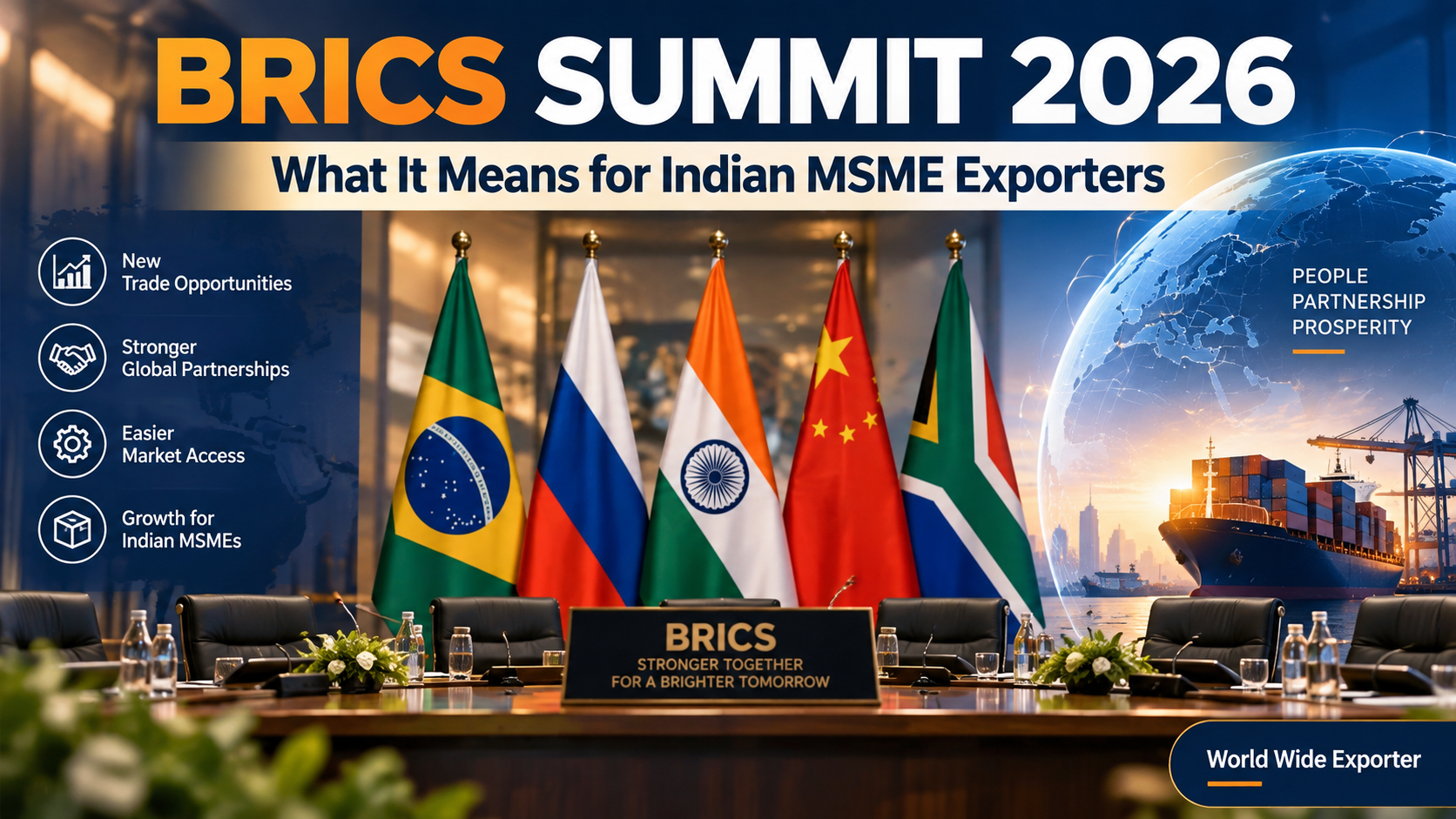
New Delhi, September 12, 2026 — As the 18th BRICS Summit gets underway at Bharat Mandapam, the conversation inside the conference halls is shifting from grand political statements to a much sharper question: what does this actually mean for the exporter sitting in Tirupur, Surat, Ludhiana, or a Noida-NCR industrial unit? This piece breaks down the trade and MSME outcomes of BRICS Summit 2026 and what Indian exporters should realistically expect — and do — next.
BRICS Summit 2026: What It Means for Indian MSME Exporters
Quick summary: India hosted the 18th BRICS Summit in New Delhi on September 12–13, 2026, with MSME internationalisation as a core trade priority. Key outcomes include a BRICS MSME Cooperation Portal, a proposed Invoice Discounting Mechanism, and a Global Value Chains Action Plan (2026–2030). For Indian exporters, the summit signals intent — but the real test is whether these mechanisms translate into faster clearances, recognised standards, and actual export orders.
Key Takeaways
- 18th BRICS Summit held in New Delhi, September 12–13, 2026, under India's chairship
- MSMEs account for roughly 40–45% of India's total merchandise exports, making them central to the summit's trade agenda
- India's trade with other BRICS members touched around $417.5 billion in FY2025-26, but with a merchandise trade deficit of roughly $226.1 billion
- New mechanisms proposed: MSME Cooperation Portal, Invoice Discounting Mechanism, Global Value Chains Action Plan 2026–2030
- Sectors positioned to benefit most: electronics, pharmaceuticals, engineering goods, textiles, chemicals, agri-products
- Industry bodies like FIEO and ASSOCHAM are pushing for measurable commercial outcomes, not just declarations
What Is BRICS Summit 2026 — Quick Context
The 18th BRICS Leaders' Summit was hosted by India at Bharat Mandapam, New Delhi, on September 12–13, 2026. This marks India's fourth time chairing the grouping, having previously done so in 2012, 2016, and 2021, and coincides with BRICS completing 20 years since its founding.
India's chairship theme, "Building for Resilience, Innovation, Cooperation and Sustainability," reflects a deliberate shift from broad geopolitical positioning toward implementation-focused, business-relevant outcomes. Over the course of the year, India hosted more than 350 meetings across 25+ cities, spanning political, economic, and people-to-people tracks.
BRICS today includes 11 full members — Brazil, China, Egypt, Ethiopia, India, Indonesia, Iran, Russia, Saudi Arabia, South Africa, and the UAE — alongside partner countries such as Belarus, Bolivia, Cuba, Kazakhstan, Malaysia, Nigeria, Thailand, Uganda, Uzbekistan, and Vietnam. Together, the bloc represents close to half the world's population and roughly 40% of global GDP.
Why This Summit Matters for Indian MSME Exporters
For an exporter, summits and declarations are usually background noise — until they change something concrete: a tariff, a certificate, a financing option. BRICS Summit 2026 is worth paying attention to because, for the first time, MSME internationalisation was treated as a headline trade priority rather than a side conversation.
The numbers explain why. MSMEs contribute close to $190 billion in exports, representing roughly 40–45% of India's total merchandise exports. Yet India's trade relationship with BRICS partners remains lopsided: total India-BRICS trade in FY2025-26 stood at approximately $417.5 billion, with Indian exports at just $95.7 billion against imports of $321.8 billion — a deficit of around $226.1 billion.
That imbalance is precisely the gap the summit's MSME-focused mechanisms are meant to address, at least on paper. Whether they do so in practice depends on implementation, not intent.
Key Trade & MSME Outcomes Explained
BRICS MSME Cooperation Portal
A proposed digital portal intended to connect MSMEs across member countries with buyers, technology partners, and financing options. The stated goal is straightforward: help a manufacturer find a buyer, and a startup find an investor, without navigating fragmented, country-specific channels.
BRICS Invoice Discounting Mechanism
Emerging from the Jaipur Consensus, this mechanism proposes a study into invoice discounting for export-oriented MSMEs, alongside guiding principles for assessing export credit. In plain terms, it targets one of the most persistent pain points for small exporters: waiting 60–90 days to get paid while working capital stays locked up.
Global Value Chains Action Plan 2026–2030
This action plan aims to strengthen trade corridors and formally integrate export-oriented MSMEs into cross-border supply chains, rather than leaving them dependent on large intermediaries or single-buyer relationships.
Startup Innovation Fund & Incubator Network
Alongside MSME-specific measures, the summit's industry track adopted an action plan on innovation-led growth, including a proposed BRICS Startup Innovation Fund and an incubator network linking startup ecosystems across member countries.
Old vs New: How BRICS Trade Mechanisms Compare
| Trade Friction Point | Pre-2026 Situation | BRICS Summit 2026 Proposal |
|---|---|---|
| Buyer discovery for MSMEs | Fragmented, largely informal or agent-dependent | BRICS MSME Cooperation Portal |
| Export invoice financing | Limited access, high collateral requirements | Proposed Invoice Discounting Mechanism |
| Supply chain integration | Ad hoc, dependent on individual buyer relationships | Global Value Chains Action Plan 2026–2030 |
| Certification & standards recognition | Duplicate testing/certification across borders | Standardisation memorandum (in principle) |
| Customs clearance | Repeated inspections at both ends | Customs cooperation agreement (approved in principle) |
Sector-Wise Opportunities for Indian Exporters
- Electronics: India's electronics exports to BRICS nations rose 49.27% in FY2025-26, outpacing overall export growth of 26.53%, with UAE and China as the largest destinations.
- Pharmaceuticals: Positioned as a core strength alongside engineering goods, chemicals, and IT services, with existing competitive capability across BRICS markets.
- Textiles: Clusters like Tirupur and Ludhiana stand to benefit from smoother certification and reduced duplicate testing if the standardisation memorandum moves from principle to practice.
- Engineering goods & auto components: Flagged repeatedly by industry bodies as sectors with room to grow within BRICS value chains.
- Agricultural products: ASSOCHAM projects India's exports to BRICS could nearly double to around $200 billion by 2030, with agriculture among the sectors expected to contribute.
Marketplace Observation: What We're Seeing on the Ground
From WWE's vantage point working with export-oriented MSMEs across sectors, the gap between policy announcement and buyer-side action is usually 12–18 months. Portals and financing mechanisms announced at summits typically take a full budget cycle before regional trade offices operationalise them for a first-time exporter. Businesses that benefit fastest tend to be those already export-ready — documentation in place, digital presence established — rather than those waiting for a scheme to onboard them from scratch.
Marketplace Observation: The Documentation Gap We Keep Seeing
One recurring pattern we track across export-oriented MSMEs on our platform: the businesses most excited about BRICS-level announcements are often the least prepared to act on them. When we onboard new exporters, the single biggest delay to their first international enquiry isn't demand — it's incomplete company verification, missing product certifications, or catalogues that haven't been updated in over a year. If the MSME Cooperation Portal does launch on the timeline suggested, early movers will be the exporters who treated "getting discovered" as infrastructure to build now, not a switch to flip once a scheme goes live.
Challenges & Realistic Roadblocks
Industry bodies have been candid about this. FIEO President S C Ralhan noted that BRICS should move beyond strategic dialogue to measurable commercial outcomes, calling for easier market access to be the real test of value for Indian businesses.
A commentary in Blitz India Media framed the conversion test even more specifically: does the customs agreement actually shorten a clearance? Does the standards memorandum remove a duplicate test? Does the MSME portal produce a first order for a firm that hadn't exported before? These questions can only be answered with data over the next year, not at the summit itself.
Additional friction points worth tracking: local-currency settlement mechanisms remain constrained by liquidity and regulatory hurdles, and India's structural trade deficit with BRICS partners means export gains will likely be gradual rather than immediate.
What Should Indian MSME Exporters Do Now
- Get export documentation and certifications audit-ready — so you're positioned to move fast once standardisation or customs agreements are implemented.
- Track the BRICS MSME Cooperation Portal launch — register early once it's operational rather than waiting for wide publicity.
- Explore invoice discounting options as they roll out — particularly if working capital cycles are currently a bottleneck.
- Build digital buyer-discovery presence now — portals and B2B platforms reward exporters who already have verified profiles and product catalogues ready.
- Watch sector-specific signals — electronics, engineering goods, and textiles are moving fastest; align outreach accordingly.
Industry Voices
Commerce and Industry Minister Piyush Goyal highlighted at the BRICS Business Forum that exports from BRICS countries collectively grew from about $900 billion in 2003 to $6 trillion in 2024, underlining the scale of opportunity within the bloc. Meanwhile, ASSOCHAM projects that India's exports to BRICS nations could nearly double to around $200 billion by 2030, driven by expanding trade opportunities and stronger economic ties.
Frequently Asked Questions
1. What is the BRICS Summit 2026 and when was it held?
The 18th BRICS Summit was hosted by India in New Delhi at Bharat Mandapam on September 12–13, 2026, under the theme "Building for Resilience, Innovation, Cooperation and Sustainability."
2. How does BRICS Summit 2026 benefit Indian MSME exporters?
Through proposed mechanisms like the MSME Cooperation Portal, an Invoice Discounting Mechanism, and the Global Value Chains Action Plan 2026–2030, aimed at improving market access, financing, and supply chain integration for export-oriented MSMEs.
3. What is the BRICS MSME Cooperation Portal?
A proposed digital platform meant to connect MSMEs across BRICS countries with buyers, technology partners, and financing options, reducing dependence on fragmented, country-specific channels.
4. What is the BRICS Invoice Discounting Mechanism?
A mechanism under study, emerging from the Jaipur Consensus, aimed at helping export-oriented MSMEs access financing against unpaid invoices, easing working capital pressure.
5. Which sectors benefit most from BRICS Summit 2026 outcomes?
Electronics, pharmaceuticals, engineering goods, chemicals, textiles, and agricultural products are the sectors most frequently cited by industry bodies as positioned to gain.
6. What is India's trade deficit with BRICS countries?
India's trade with other BRICS members reached around $417.5 billion in FY2025-26, with exports of about $95.7 billion against imports of $321.8 billion — a deficit of roughly $226.1 billion.
7. Is BRICS Summit 2026 the first time MSMEs were a summit priority?
It's the first time a dedicated BRICS MSME Forum was held, in Agra in June 2026, ahead of the leaders' summit, signalling a formal institutional shift toward small business priorities.
8. How much could India's exports to BRICS grow by 2030?
ASSOCHAM projects India's exports to BRICS nations could nearly double to around $200 billion by 2030.
9. What is the Global Value Chains Action Plan 2026–2030?
An action plan adopted by BRICS members to strengthen trade corridors and formally integrate export-oriented MSMEs into cross-border supply chains.
10. Will BRICS Summit 2026 outcomes have immediate effects for exporters?
Not immediately. Most mechanisms are in proposal or "approved in principle" stages; industry bodies expect measurable commercial outcomes to take shape over the following year, not at the summit itself.
11. How did India's electronics exports to BRICS perform recently?
India's electronics exports to BRICS nations rose 49.27% in FY2025-26, outpacing the country's overall export growth of 26.53% for the same period.
Conclusion
BRICS Summit 2026 has put MSME exporters at the centre of its trade agenda in a way previous summits didn't — on paper, at least. The Cooperation Portal, Invoice Discounting Mechanism, and Global Value Chains Action Plan all address real, long-standing pain points for Indian exporters. But as FIEO and industry commentators have pointed out, the real test isn't the declaration; it's whether a customs agreement actually shortens a clearance, or whether a first-time exporter gets their first order through the new portal. That verdict will take a year of implementation data, not a two-day summit, to deliver.
For exporters, the practical move right now isn't to wait for these mechanisms to mature — it's to be export-ready before they do.
A caveat worth keeping in mind: much of what's described above — the MSME portal, the invoice discounting mechanism, the standardisation and customs agreements — is currently at the "proposed" or "approved in principle" stage. None of it is a guarantee of faster clearances, easier financing, or new buyers. Treat this summit as a signal of direction, not a finished outcome, and verify implementation timelines through official channels (Ministry of Commerce, DGFT, or your export promotion council) before making business decisions based on it.
Ready to get discovered by global buyers before these mechanisms even launch? List your business on WorldWideExporter.com and build the verified export profile that buyers — and future BRICS-linked platforms — will be looking for.